


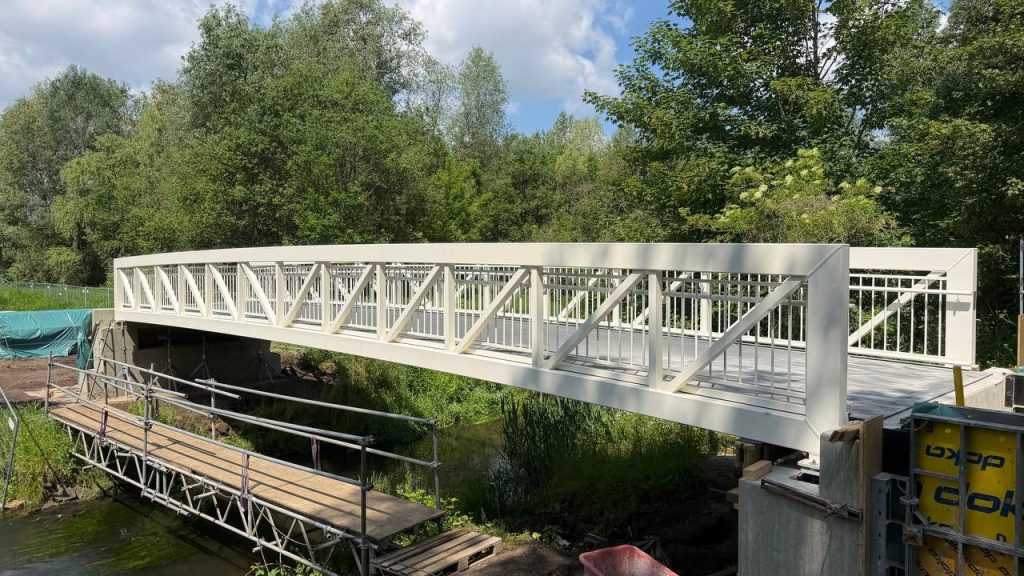
The best material for a footbridge is the one that suits the span, the access for a crane and the maintenance budget the owner can really commit to. Aluminium usually leads where weight and site access are the constraints, timber suits short rural crossings, concrete suits fixed sites with good access, and fibre-reinforced polymer competes on light spans where stiffness is not critical.
Comparisons often stop at purchase price. The properties below explain most of what happens after that, from the size of the crane to the work the owner pays for over the following decades.
Footbridge materials compared by weight, stiffness and upkeep
| Material | Density, kg/m³ | Stiffness, GPa | Main upkeep |
|---|---|---|---|
| Aluminium | 2,700 | 70 | Inspection, cleaning |
| Structural steel | 7,850 | 210 | Coating renewal |
| Glulam timber | about 450 | 11–14 | Protection, part replacement |
| Pultruded FRP | 1,800–2,000 | 20–30 | Inspection, surface wear |
| Beton | about 2,400 | 30–35 | Joints, crack repair |
These are typical values for orientation, and the figures for timber and FRP vary by product. Density alone misleads, because a material that is three times lighter and three times less flexible needs deeper sections to carry the same crowd.
Aluminium footbridges: where they win and where they do not
An aluminium footbridge is light enough to change the installation. On our delivered bridges the structure weighs between 74 and 145 kg per square metre of deck, as shown in our table of aluminium bridge weights, which allows a smaller crane and a shorter closure over a road or railway.
Aluminium protects itself with an oxide layer, so an uncoated or anodised structure needs no paint to resist corrosion, while a painted one needs its finish renewed for appearance like any other painted surface. Its weaknesses are a higher material price, lower stiffness that has to be designed for, and galvanic corrosion where it meets other metals without proper isolation.
Steel footbridges: stiff, familiar and dependent on their coating
Steel gives the highest stiffness in the table, and every contractor knows how to build with it, which is why it remains common for long or heavily loaded spans. The cost arrives later in the form of coating renewal, often over water or live traffic, and the lifecycle cost of that work belongs in the comparison from the start.
Timber footbridges: suited to short spans and sheltered details
Timber is the lightest structural option here and fits rural paths and parks well. Its service life depends on keeping water out of the connections, so detailing, covering and inspection matter more than the species. Decks and exposed members are often replaced during the life of the bridge, and heavy public use or service vehicles narrow its range quickly.
FRP footbridges: light and durable, limited by stiffness
Fibre-reinforced polymer resists corrosion and arrives in light sections, so it suits difficult access and aggressive environments. Its modulus is low, which makes deflection and vibration the governing checks as spans grow. The same trade-offs that decide a GRP or aluminium walkway apply at bridge scale, with fire behaviour and surface wear worth asking about.
Concrete footbridges: durable mass that needs access
Concrete suits fixed sites where heavy lifting and larger foundations are acceptable, and its mass helps to damp movement. The weight is also its limit: over a railway, on soft ground or at a site with restricted crane access, foundations and lifting can outweigh the saving on material.
Why stiffness decides lightweight footbridge design
Light footbridges are rarely limited by strength. As mass and stiffness fall, natural frequencies move toward the rate of human footsteps, which is why some bridges shake while carrying their loads with an ample margin. Whichever material you consider, state the frequency and acceleration limits in the brief rather than leaving them to the supplier.
Which footbridge material suits which site
| Byggepladsforhold | Usually leads | Main reason |
|---|---|---|
| Short railway possession | Aluminium | Light, single lift |
| Restricted crane access | Aluminium, FRP | Light sections |
| Kystudsættelse | Aluminium, FRP | No protective coating |
| Short rural path | Timber | Low weight, appearance |
| Fixed site, easy access | Beton | Mass, robustness |
| Heavy loads, long span | Steel, concrete | Høj stivhed |
What to put in the brief before choosing a footbridge material
State the span, the clear width, the imposed load and any service vehicle, then add the access limits for transport and lifting and the maintenance the owner can realistically fund. Ask bidders to price the structure together with its inspection and coating regime over the design life, so that a cheap purchase and a cheap crossing can be told apart.
If the site points toward a light structure, we can review the brief and give the weight, transport units and installation method for an aluminium pedestrian bridge before it goes to market.