


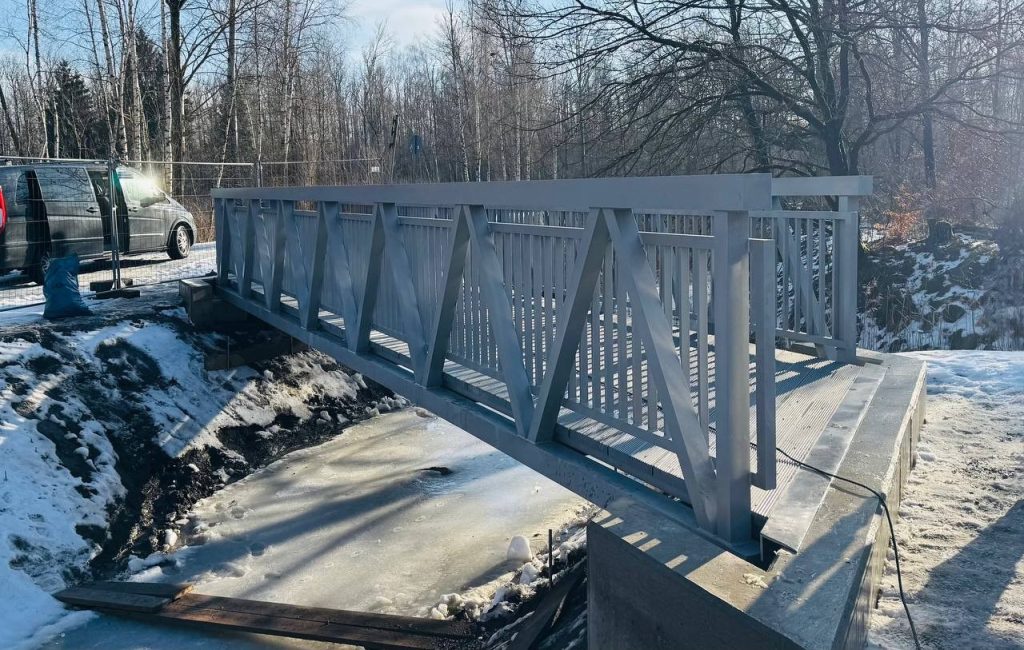
Bridge maintenance cost is not one line in a budget, it is four, and they behave completely differently. Two of them are small, predictable and easy to plan. One is large, infrequent and easy to defer until it becomes urgent. The fourth is unpredictable by definition.
Separating them is what makes an honest thirty-year figure possible, and it is also what reveals where the money really goes, which is rarely into the work itself.
Inspection
Every bridge in public ownership sits under an inspection regime, typically with frequent visual checks and a more detailed structural inspection at longer intervals. The frequent ones are cheap. The detailed ones require access to every part of the structure, and that is where the cost sits.
For a short, simple span at low level, a detailed inspection is a morning’s work. For a crossing over a road or a railway it requires access equipment, traffic management or a possession, and the inspection itself becomes the smaller part of the invoice. Structures with complex sections, enclosed voids or inaccessible connections cost more to inspect for the whole of their lives, which is an argument for simple, inspectable detailing at design stage.
Routine work
Cleaning drainage, clearing debris, washing down where salt is present, checking and tightening fixings, replacing lamps and dealing with small defects. This is a day or two a year on a typical footbridge, and it is the part of the regime most often skipped because nothing visible happens if it is.
Skipping it is expensive later rather than free. Blocked drainage puts standing water on a deck; standing water accelerates every corrosion mechanism there is; and on a coated structure it takes the coating out early. The routine line is the cheapest insurance in the whole model.
Planned intervention
This is the big one, and on a coated steel structure it is dominated by recoating. A protective system has a service life, and at the end of it the structure needs cleaning, preparing and repainting, with containment to catch the removed material. The paint is a minor part of the cost. Access, containment, traffic management and the programme are the rest.
Alongside recoating sit the component replacements: bearings, expansion joints and deck surfacing, each with its own interval. A short simply supported span may have no bearings or joints worth speaking of, which removes two lines entirely, and that is one of the quieter arguments for keeping a small crossing structurally simple.
An uncoated or anodised aluminium structure does not have a recoating cycle at all, which removes the largest planned item from the model. What it does have is an inspection and washing regime, fastener checks, and in marine exposure the replacement of sacrificial anodes. The trade-off between finishes and what each commits an owner to is set out in our comparison of the three finish options and their maintenance consequences.
Reactive repair
Vehicle strikes on crossings over roads, damage from debris in a watercourse, vandalism and graffiti. None of it is predictable for an individual structure and all of it is predictable across a portfolio, which is why it belongs in a model as an annual allowance rather than as a scheduled event.
Graffiti deserves its own note because it is the most common reactive cost on an urban footbridge and because the finish decides how expensive it is. Some surfaces release paint readily and some absorb it, and a structure in a location where graffiti is certain should be finished accordingly rather than optimistically.
Access is the multiplier, not the work
The single most useful idea in bridge maintenance economics is that the cost of a task is mostly the cost of reaching it. Two structures needing identical work can differ by an order of magnitude in what that work costs, depending on whether it can be done from the deck with a ladder or requires a road closure and a mobile platform.
This has a direct design consequence. Detailing that keeps components reachable, avoiding enclosed voids that cannot be inspected, and positioning services so they can be replaced without dismantling structure are decisions made once and paid for or saved every few years thereafter.
Deferred maintenance is a debt with interest
Public clients defer maintenance because capital and revenue budgets are separate and revenue is tighter. The pattern is familiar and its economics are unforgiving: a coating allowed to fail lets corrosion start, and repairing corroded steel costs several times what recoating sound steel would have cost.
The defensible response is not to promise that maintenance will happen. It is to choose structures whose maintenance requirement is small enough that deferral does not create a liability, which changes the question at procurement stage from what does it cost to build into what does it commit us to.
What to require from bidders
Ask for a maintenance schedule listing every task, its interval, its duration and the access method it assumes. Ask for the total days of closure over the appraisal period. Ask what the coating or finish warranty period is and in what environment classification. Ask which components are expected to be replaced within the period and at what interval.
Four questions, all answerable in a page, and they turn a promise of low maintenance into a schedule that can be checked and costed. A supplier who cannot produce one has not thought about the asset past handover, and the capital figure in their offer should be read with that in mind.
Before the structure is chosen
Thirty years of maintenance is not a tail on a capital decision; on a durable asset it is comparable in size to the capital itself, and it is spent by people who will not be in the room when the purchase is made.
The maintenance plan for every structure we supply names the tasks, the intervals and the access each one needs, and the documentation held by DR VERSLAS includes it as a deliverable rather than as a statement that the structure is maintenance-free.