


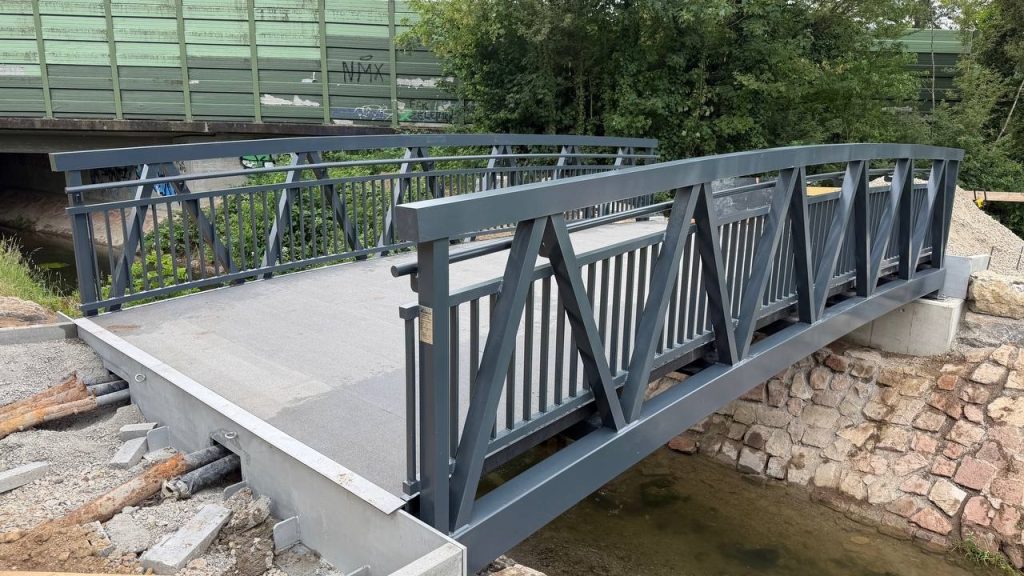
Crowd loading is the imposed load a structure is designed to carry when the people on it are packed together rather than spread out, and European practice expresses it as a uniformly distributed load in kilonewtons per square metre. Almost every specification quotes 5 kN/m². Far fewer say where the figure came from, and that is what decides whether it is the right one for the structure being bought.
The question is not academic. The category assigned to a viewing platform, a walkway or a footbridge sets the deck thickness, the beam depth and the loads that reach the foundations, so a structure designed one category too low is cheaper to build and wrong to use.
Which categories apply to areas used by people
EN 1991-1-1 sorts occupancies into categories, and three of them cover situations where people gather in numbers. The distinction between them is not how many people fit, but what those people are doing.
| Category | What it covers | Recommended qk |
|---|---|---|
| C3 | Moving people, no obstacles | 3.0 to 5.0 kN/m² |
| C4 | Physical activity | 4.5 to 5.0 kN/m² |
| C5 | Large crowds | 5.0 to 7.5 kN/m² |
Category C3 covers areas without obstacles to movement: museums and exhibition rooms, access areas in public and administrative buildings, hotels and hospitals, and station forecourts. C4 covers areas where physical activity is expected, such as dance halls, gymnasia and stages. C5 covers areas susceptible to large crowds, which the standard illustrates with concert halls, sports halls including their stands, terraces and access areas, and railway platforms.
A viewing platform in a park is usually C3 or C4 depending on how it is used, while a platform at an event venue or a river crossing beside a stadium is C5. The wording of the categories rewards a few minutes of honest thought about the busiest day of the year rather than the average one.
Why 5 kN/m² is a recommendation rather than a rule
The values in the table are ranges, and they are ranges on purpose. The Eurocode publishes recommended figures and leaves the actual choice to each country, which fixes the value in its National Annex. A specification that says the structure shall be designed for 5 kN/m² in accordance with the Eurocode may be quoting the correct national value or may be sitting below it, and nothing in the sentence itself reveals which.
For a cross-border purchase this is the single most common source of trouble. A design produced in one country and installed in another has to satisfy the annex of the country where the structure will stand, not the one where it was drawn, and the imposed load is exactly the sort of parameter that differs.
A bridge is not a building
The categories above come from the part of the Eurocode that deals with buildings. A footbridge is a bridge, and bridge traffic loads live in EN 1991-2, where the recommended uniformly distributed load for a footbridge depends on the loaded length rather than on an occupancy category. The recommended expression is qfk = 2.0 + 120 / (L + 30), bounded below at 2.5 kN/m² and above at 5.0 kN/m².
The logic behind the formula is worth understanding because it explains a result that looks wrong at first glance: the longer the span, the lower the design load per square metre. A ten-metre crossing packed end to end is an ordinary occurrence, while a hundred-metre crossing packed end to end at the same density is not, and the Eurocode reflects that probability rather than pretending both are equally likely.
The practical consequence is that a viewing platform and the footbridge leading to it can carry two different design loads and both be correct. Our engineers set out which figure applies to which part of a structure in the calculation package, because the design standard for the aluminium itself assumes the loads have already been established elsewhere.
A crowd moves, and a static figure does not describe that
The Eurocode draws explicit attention to dynamic effects for categories C4 and C5, and the reason is that people in a crowd synchronise. Footfall on a lively structure tends to fall into step with the structure rather than the other way round, and the effect grows with the number of people, which is why a platform can satisfy every static check and still feel unusable when it is full.
Aluminium structures deserve particular care here. The metal is about a third as stiff as steel for the same section, so serviceability rather than strength often governs the design, and the frequency of the finished structure is a design output that should be declared rather than discovered on opening day.
The parapet carries a load as well
Attention in a specification usually goes to the deck, and the barrier is treated as joinery. It is not. Parapets and balustrades are designed for a horizontal line load applied at handrail height, and where overcrowding is possible the line load associated with category C5 applies to the barrier even when the deck itself sits in a lower category.
This is the item most often missing from a tender document, and it is an expensive omission because the barrier fixings and the posts that carry them are built into the deck structure. Adding the requirement after fabrication has started means changing the deck, not the railing.
What a specification has to state
Five lines cover it. Name the occupancy category. State the design value in kN/m² and the National Annex it comes from. Say whether the structure is being treated as a bridge or as a building, because that decides which part of the Eurocode supplies the load. State the horizontal line load for the barrier. Finally, say whether a dynamic assessment is required and what comfort criterion the finished structure has to meet.
That last line is the one that separates a specification written by someone who has commissioned a structure before from one written from a template. A comfort criterion turns a subjective complaint into a measurable acceptance test, and it costs nothing to include.
Before the platform is designed
The 5 kN/m² figure is a reasonable starting point and a poor finishing point. It is a recommended value inside a range, the range is settled nationally, and a structure treated as a bridge arrives at its number by a different route entirely. None of that is difficult, but none of it happens by itself if the tender document is silent.
Our engineers will review a draft load specification before it goes to market and state the categories and values that apply in the country of installation. The aluminium viewing platforms and walkways we build are designed to the category the client names, and the loads used are published in the calculation package so the client’s own engineer can check them rather than take them on trust.