


There is no single European answer to how often a bridge has to be inspected. Inspection regimes are national, and within a country they are usually set by the road or rail authority and applied by the owner, so a municipal footbridge in one member state and an identical one in another can sit under quite different requirements.
What is consistent is the shape of the regimes. Almost all of them use two levels at different intervals, plus a third category triggered by events, and understanding that structure is more useful than memorising any one country’s numbers.
The two-tier pattern
The first level is a frequent, largely visual check carried out from ground level and from the deck, looking for damage, deterioration, blocked drainage and anything obviously wrong. It is quick, it does not usually need access equipment, and in most regimes it happens every year or every two years.
The second level is a detailed structural inspection with close access to every element, including the underside and the connections. It takes longer, generally needs access equipment or a closure, and is carried out at a longer interval, commonly somewhere in the range of three to six years depending on the country and the owner.
The third category is the special inspection, triggered by an event rather than a calendar: a vehicle strike, a flood, exceptional loading, or a finding from a lower-level inspection that needs following up. These are not scheduled and they should not be deferred to the next cycle.
What shortens the interval
Regimes allow the interval to be reduced, and several conditions justify it. An aggressive environment, meaning coastal exposure or heavy use of de-icing salt, accelerates everything and argues for more frequent attention. A structure with known defects under monitoring needs looking at on a timescale matched to how fast the defect is moving.
Age matters less than people assume and redundancy matters more. A structure where a single element failing would drop the span deserves closer attention than one with alternative load paths, regardless of how old either is. So does a structure whose critical elements cannot be seen without special access, because the inspection that gets deferred is always the one that is difficult.
Traffic is the last factor. A crossing carrying a few people a day and one carrying a thousand present the same structural risk and very different consequence, and consequence is what inspection frequency is really managing.
Who is allowed to do which
The first-level check is normally carried out by trained maintenance staff working to a defined form. It does not require an engineer, and requiring one makes it expensive enough that it stops happening at the specified frequency, which is the worst outcome.
The detailed inspection is a different matter. It involves judgement about whether what is visible matters structurally, and the regimes generally require a suitably qualified engineer, in some cases with specific accreditation. Where the inspection includes elements underwater or inside enclosed sections, further specialist competence applies.
The practical implication for a small owner is that the cheap, frequent level can be resourced in-house and the expensive, infrequent level has to be procured. Both belong in the budget and only one of them tends to be there.
The inspection nobody carries out
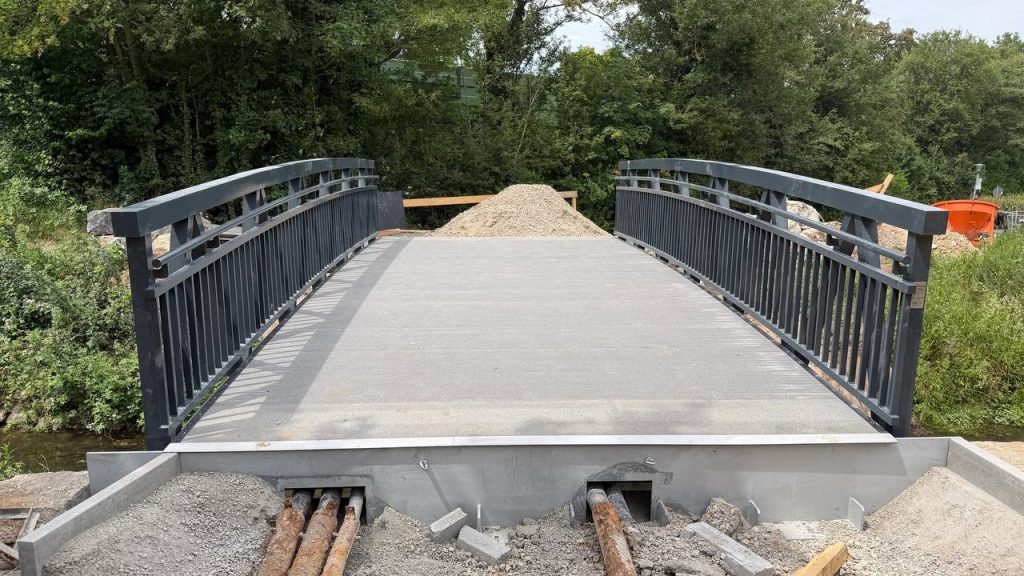
The most valuable inspection in the life of a structure is the one taken immediately after handover, when nothing has happened to it yet. It establishes the baseline: what the bearings looked like when new, where the datum marks are, what the connections were like before twenty winters.
Without that record, every subsequent finding starts with an unanswerable question about whether the condition is new. With it, the same finding becomes a measurable change. It costs a morning and it is left out of almost every contract.
What material changes about the regime
Inspection frequency is set by consequence and environment rather than by what the structure is made of, so a regime does not relax because a bridge is aluminium. What changes is what the inspector is looking for. On a coated steel structure the primary subject is the condition of the coating, because the coating is the protection and its failure starts a clock.
On an uncoated or anodised aluminium structure there is no coating to assess, and attention moves to the connections, to contact with other metals, and to drainage. It is a shorter list and it does not shrink the calendar, which is a point worth making to any client who reads low maintenance as no inspection. What each level should cover element by element is set out in our inspection checklist for a municipal crossing.
What an owner should have in place
Identify the regime that applies and write down which document it comes from, because that is the question that arises after an incident. Set the two intervals and name who carries out each. Define the trigger events that require a special inspection. Fix the recording format so visits are comparable. Take the baseline record at handover, or as close to now as possible if the structure already exists.
Five items, none of them expensive, and together they convert an obligation that is easy to let slip into a routine that survives staff changes.
Before the next cycle is planned
Inspection is the cheapest part of owning a structure and the first thing cut when budgets tighten, largely because nothing visibly bad happens in the year it is skipped. The cost of skipping it appears later, as a repair that a timely finding would have prevented.
Every structure we supply is handed over with an inspection schedule naming the intervals, the access each level requires and the baseline record, and the Dokumentation im Besitz von Dr. Versalas is assembled so that a future inspector can compare what they see against what was built.