


Eurocode 9, published as EN 1999, is the European standard for the design of aluminium structures. It answers the question of whether a structure is strong and stiff enough, which is a different question from how it is manufactured. A specification that names one and not the other leaves half the job undefined, and that happens often enough to be worth setting out plainly.
This article is for people who commission aluminium structures rather than calculate them: what the standard covers, where it differs from the steel equivalent, and what to require in a tender so the answers come back comparable.
Where it sits among the other standards
The division is clean once it is stated. Eurocode 9 governs design: section sizes, joint capacity, deflection, stability, fatigue life. EN 1090-3 governs execution: how the designed structure is actually fabricated, welded, treated and documented. One decides what the structure must be, the other decides whether what arrives on site matches.
Both are needed, and naming only the execution standard in a specification produces good manufacturing of an undefined structure. The reverse — naming Eurocode 9 alone — produces a correct calculation with no control over what is welded.
The parts, and the one that is missing
Eurocode 9 is divided into five parts. Part 1-1 carries the general structural rules, part 1-2 covers structural fire design, part 1-3 covers structures susceptible to fatigue, part 1-4 covers cold-formed structural sheeting and part 1-5 covers shell structures.
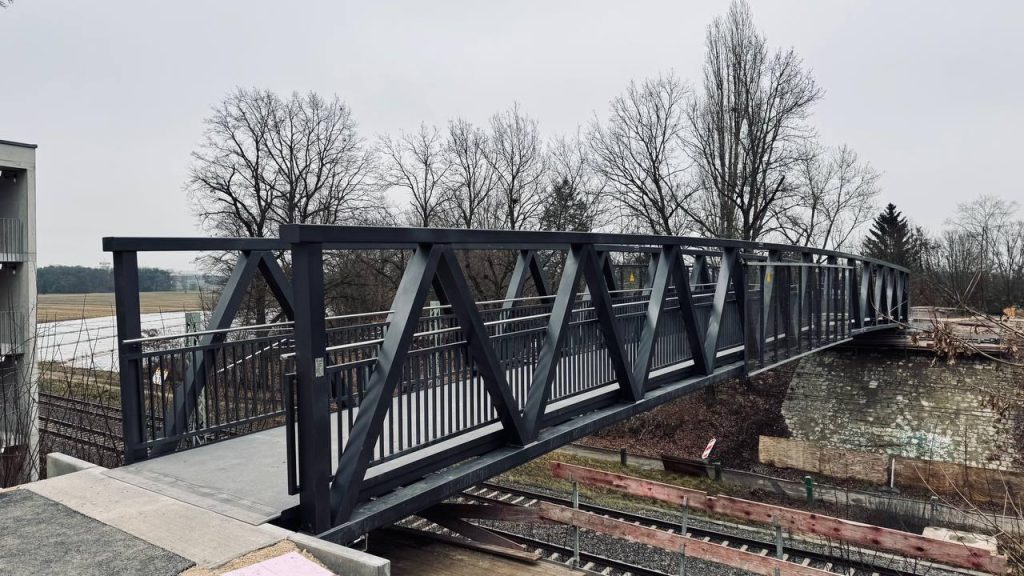
What is not there is worth noticing. Eurocode 3, the steel equivalent, has separate parts for bridges, towers and crane supporting structures. Eurocode 9 has none of those: part 1-1 covers all structural applications, with material selection, members and joints handled in the same document. An aluminium footbridge is designed to the same general part as an aluminium canopy.
The practical consequence for a specification is that there is no bridge-specific part to cite. What makes a design a bridge design is the combination of Eurocode 9 with the loading and fatigue requirements that apply to a crossing, not a separate chapter of the aluminium standard.
Three things that make aluminium different
Aluminium is not light steel. Three properties change the design in ways that show up directly in what a structure costs and how it behaves in service.
Stiffness. The modulus of elasticity of structural aluminium is taken as about 70 000 N/mm², roughly a third of the figure used for steel. Strength can be compensated for by choosing an alloy or adding material; stiffness cannot, because it is a property of the metal. The consequence is that deflection at the serviceability limit state frequently governs the design of an aluminium structure rather than strength. For a footbridge this is the mechanism behind the bouncy-bridge problem: a span that is perfectly safe can still feel wrong underfoot.
Welds soften the metal around them. Heat from welding reduces the strength of the parent material in a zone either side of the weld, and Eurocode 9 handles this explicitly with softening factors applied in that heat-affected zone. The size of the reduction depends on the alloy series and the welding process; in the 6xxx alloys commonly used in structural work, the local strength can fall to around half that of the parent material. The tabulated factors also assume particular processes and thicknesses, and outside those assumptions larger reductions apply.
This is why weld placement in aluminium is a structural decision rather than a detailing preference, and why a structure assembled with bolted connections on site keeps its welds where they were designed to be: in the factory, in controlled conditions, at the positions the calculation assumed.
Fatigue. Repeated loading matters more in aluminium than in steel, and Eurocode 9 gives it a part of its own. For a crossing used by a few hundred people a day, fatigue is not a theoretical check; it drives the detailing of the joints, and it is the reason a footbridge cannot be designed as though it were a static canopy of the same span.
Alloy and temper are part of the specification
Aluminium is not one material. A structural member is defined by its alloy and its temper together, written in a form such as EN AW-6082 T6, and the two determine strength, weldability, corrosion behaviour and how much the metal loses near a weld.
For a client this matters at tender stage. Two quotations for the same span can use different alloys, and the cheaper one may be cheaper because it is a lower-strength temper that will deflect more. Requiring the alloy and temper to be stated in the offer makes the comparison honest, and it costs nothing to ask.
What to require in the specification
Three items cover most of it. Require that the structural design be carried out to Eurocode 9 with the national annex of the country of installation. Require that the alloy and temper of the main members be stated. Require deflection and vibration criteria to be declared rather than left to the supplier’s judgement, because that is where the difference between a comfortable bridge and an unpleasant one lives.
It is also worth requiring the calculations themselves as a deliverable, not only the conclusion. A structural report that a client’s own engineer can check is a different thing from a statement that the structure complies, and the difference becomes visible at handover rather than at tender.
Alongside that sits the execution side: naming the execution class you expect and requiring the declaration of performance among the deliverables. Design and execution are specified together or neither is specified properly.
What it looks like in a real quotation
A serious offer for an aluminium structure states the alloy and temper, cites Eurocode 9 and the national annex used, gives the deflection and frequency criteria the structure meets, and names the execution class the fabrication will follow. An offer that omits all four is not necessarily unsound, but it is not comparable with one that includes them.
Our structural calculations are produced to Eurocode 9 and issued as part of the project documentation, which means they can be checked by the client’s engineer rather than taken on trust. The same applies to the pedestrian and cycle bridges we deliver as standard spans: the design basis travels with the structure.
Before the calculation is commissioned
Eurocode 9 is not an exotic standard, but it behaves differently from the steel Eurocode in ways that catch out teams used to specifying steel. There is no bridge part to cite. Deflection is more likely to govern than strength. Welds reduce local capacity, and where they sit is a design decision. Fatigue has its own part and it applies to any crossing in daily use.
A specification that names Eurocode 9, asks for the alloy and temper, and states the serviceability criteria gets comparable offers back. One that says only that the structure shall be of aluminium gets four different structures at four different prices. Our engineers will review a draft specification against Eurocode 9 and EN 1090-3 before it goes out, and the certification and design documentation held by DR VERSLAS is published so that both halves can be checked.