Aluminium industrial bridges and access walkways, built for working environments

Certified aluminium access bridges, catwalks and inspection walkways for industrial plants, ports, fish farms and processing facilities. Spans to specification, R12 anti-slip deck, IP65-rated — with full EN 1090 documentation.
Overview

Access structures that work as hard as the facilities they serve

Industrial access bridges and walkways operate in environments that destroy painted steel — salt air, chemical exposure, wash-down water and constant foot traffic from operatives in heavy PPE. DR VERSLAS aluminium structures require no protective coating, no repainting programme and no shutdown for corrosion treatment. The deck surface is R12 anti-slip rated as standard and load specifications are calculated to the actual operational requirements of each facility — not a generic pedestrian class.

Access routes that only need the edge protection renewed are covered by our aluminium walkway railings and guardrails.
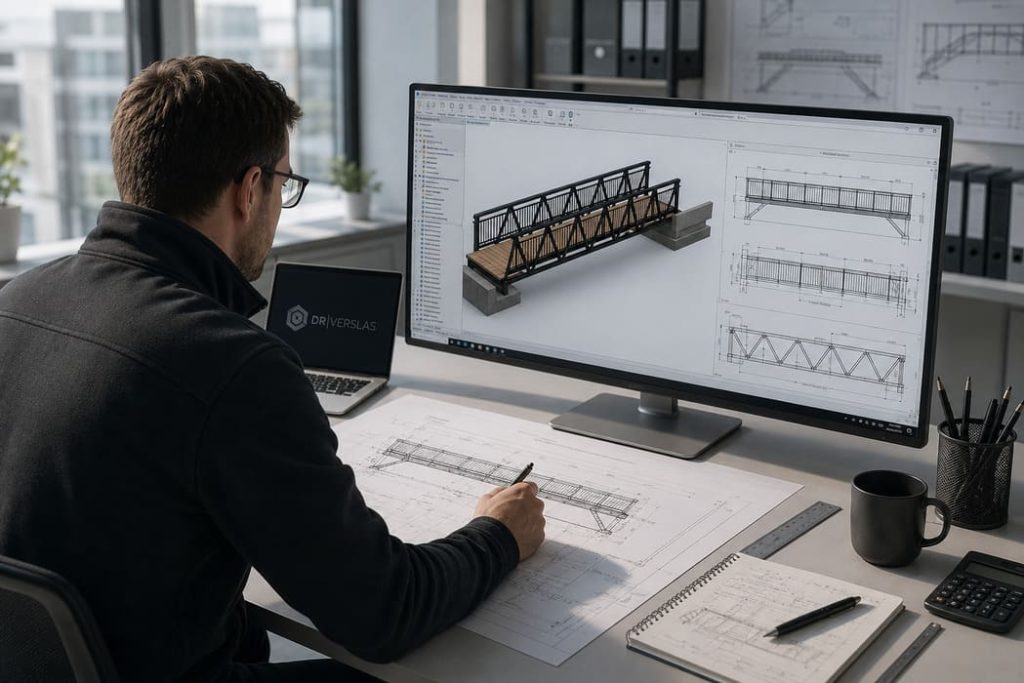
Engineer reviewing a 3D aluminium bridge model and structural drawings on screen
Reference projects

Pedestrian bridges in service across Europe

A selection of delivered footbridges — supplied to municipalities and public authorities with full EN 1090 documentation. Representative references; full register on request.
Where they go

Built for the facilities that cannot afford downtime

The same certified structure adapts to parks, dense urban links and grade-separated crossings over live traffic — configured by span, deck width and finish for each site.

Industrial plants & factories

elevated walkways, equipment access bridges and inter-building crossings at manufacturing and processing facilities.

Ports & harbours

access structures over dock infrastructure, between vessel berths and across working quaysides in high-salinity environments.

Fish farms & aquaculture

walkways over water in marine and freshwater environments where corrosion resistance is the primary structural requirement.

Water treatment & utilities

inspection bridges and access walkways over treatment infrastructure, filtration beds and utility channels.

Food processing facilities

hygienic access structures in wash-down environments, configured to food-industry cleanliness and drainage requirements.

Not sure which fits?

Send us the span, location and load — we map the right configuration to your site.
Material rationale

Aluminium vs steel vs concrete

For pedestrian, cycle and most access bridge applications, aluminium beats steel and concrete on six measurable parameters out of seven. The chart below: 54 m pedestrian bridge, 5 kN/m² load class.
Structural Weight

Aluminium is 2.5× lighter than steel

tonnes · typical 54 m structure
Aluminium
12 t
Steel
30 t
Concrete
48 t
Al density 2.7 g/cm³ vs steel 7.85 g/cm³. Real project: Rene Bridge, Austria, 55 m aluminium — 21 t vs ~60 t in steel.
Installation Time

7× faster on-site installation

weeks on site · from delivery
Aluminium
2 wk
Steel
8 wk
Concrete
14 wk
Prefabricated aluminium modules arrive ready to install. On-site time is primarily lifting, not fabrication.
Lifecycle CO₂ (manufacture + maintenance)

62% lower emissions than concrete

indexed · concrete = 100% · assumes recycled-content aluminium
Aluminium
38%
Steel
85%
Concrete
COWI independent LCA: recycled aluminium reduces CO₂ by ~70% vs steel. Figure varies with recycled-content share of the specific project.
End-of-Life Recovery

95%+ recycling rate in construction

% of material value retained as recycled material
Aluminium
95%
Steel
87%
Concrete
25%
IAI (International Aluminium Institute): over 95% of aluminium in construction is recycled at end of life. Recycling saves 95% of the energy vs primary production.
Compliance

Tender-ready documentation with every quotation

For municipal, federal and EU-funded crossings, certification is part of the buying decision. Every quote ships with the full compliance package — calculations, declarations of performance, BIM models and conformity certificates.

✓ Active
Welded aluminium structures
Execution class EXC2 for load-bearing aluminium components. CE-marked production.
✓ Active
Quality management
Documented control across design, production and installation. Audited annually.
✓ Active
Aluminium structural design
EN 1999-1-1, -1-3 applied to all load-bearing structures. Calculations available.
✓ Active
Declaration of performance
Full DoP documentation per CPR 305/2011 for every structure on EU market.
✓ Active
Environmental management
Lifecycle CO₂ reporting and recyclability documentation supplied per project.
✓ Active
Welding quality
Full quality requirements for fusion welding of metallic materials.