


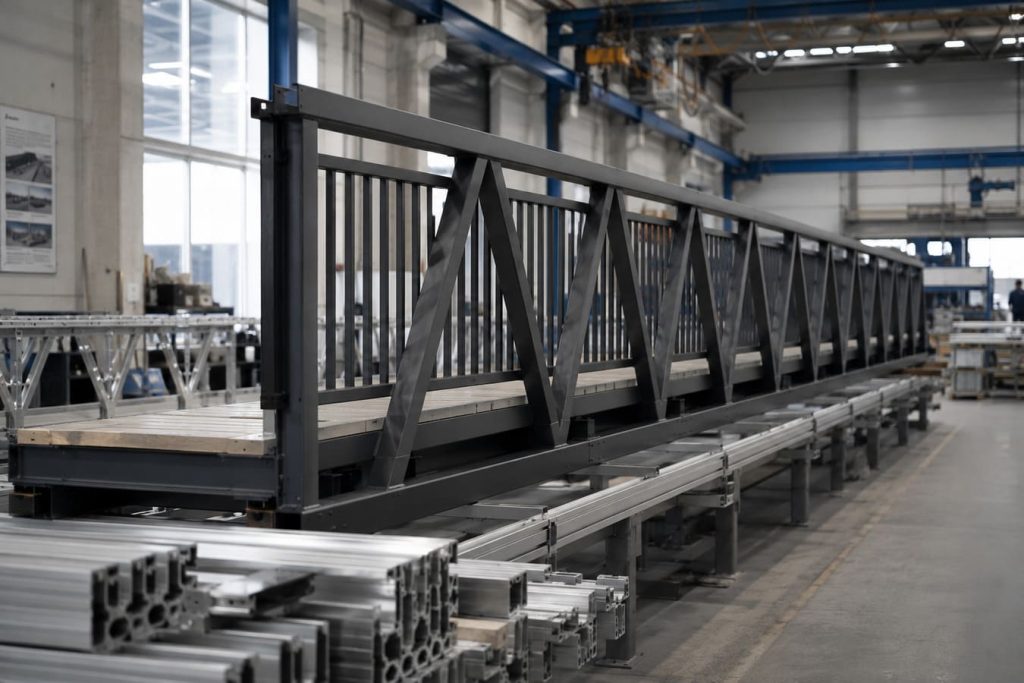
A bridge inspection checklist exists to make sure nothing is skipped, and on a small municipal crossing the things that get skipped are always the same: the drainage, the underside, and the connections nobody can reach without a ladder. Everything else gets looked at because it is at eye level.
What follows is the order to work in and what to look for at each stage. It is written for the routine visual inspection that a competent maintenance team carries out, not for the detailed structural inspection that requires an engineer, and the boundary between the two is set out at the end.
Work from the approaches inward
Start where people arrive rather than at the middle of the span, because the approaches carry the defects that generate complaints and claims. Look at the transition between the path and the structure for a step or a lip, which is the most common trip hazard on any crossing. Check the surface of ramps and stairs for wear and for ponding, and check that handrails are continuous, secure and at the right height along the whole length rather than just at the ends.
Drainage comes next and it comes before anything structural, because almost every deterioration mechanism on a bridge is driven by water that did not leave. Check that outlets are clear, that water is not tracking along the underside of the deck, and that the ground at the abutments is not saturated.
| Element | Look for |
|---|---|
| Approaches | Steps, ponding, loose surface |
| Drainage | Blocked outlets, standing water |
| Deck surface | Wear, slip, loose panels |
| Parapets | Loose posts, damaged infill |
| Connections | Missing or loose fasteners |
| Supports | Movement, cracking, scour |
The deck and what is fixed to it
Walk the full width, not the centre line. Loose or rattling deck panels, worn slip surfaces and damaged fixings show up under foot before they show up in a photograph. Where the deck is grating, check the fixing clips are present in the specified quantity, since missing clips are the usual finding and they are what stops a panel lifting.
Parapets take more abuse than any other element on a public crossing. Push each post: movement at the base is a fixing problem and it is the defect most likely to matter. Check infill panels for damage and for gaps that have opened up, and check that nothing has been added to the parapet that makes it climbable.
Connections are the part that needs a ladder
On a bolted structure, missing, loose or corroded fasteners are the finding that matters most, and they are almost always at the connections between the main members and at the parapet bases. A visual check for missing bolts and for corrosion staining running from a joint is within the scope of a routine inspection; torque checking is not.
On an aluminium structure the specific thing to look for at every connection is evidence of contact with another metal: white corrosion product around a stainless fastener, or staining where a steel component has been added. That is the mechanism that does damage fastest and it almost always arrives with a fitting installed after handover rather than with the original build.
Underneath the structure
The underside is where a routine inspection most often stops short, and it is where the load-carrying elements are. Look along each main beam for deformation, for damage from vehicle strikes where the crossing is over a road, and for corrosion at the points where water collects, which is the lowest point of any section and any ledge that does not drain.
Check the bearings or the support detail for movement, for debris packed around them and for any sign that the structure is no longer sitting as it was built. At the abutments, look for cracking, for movement relative to the ground, and where the crossing is over water, for scour around the foundations after a flood.
Everything that was added later
Lighting, signage, cable runs, cameras and planters all arrive after handover and all of them are fixed to a structure that was designed without them. Check their fixings, check they have not reduced the clear width, and check whether anything has been attached to a parapet that now carries a load it was not designed for.
This category produces more findings than any other on a twenty-year-old municipal crossing, and it is entirely absent from generic checklists.
What needs an engineer rather than a note
Four findings should stop a routine inspection and generate a request for a structural assessment: visible deformation of a main load-carrying member, cracking in a weld or at a connection, movement at a bearing or abutment that was not there before, and scour around a foundation. None of them is a maintenance item and none of them should be photographed and filed for the next visit.
Everything else is recorded, prioritised and scheduled. The distinction between defects that need action now, defects to be monitored and defects to be fixed at the next planned visit is what turns an inspection into a maintenance plan rather than a list.
The record is the point
A single inspection tells you the condition. A series tells you the rate of change, and rate of change is what decides whether something is a defect or a trend. That only works if the record is comparable between visits, which means photographs from marked, repeatable positions and a consistent form rather than free text.
The record that matters most is the first one, taken at handover before anything has happened to the structure. Almost nobody takes it, and without it every later finding is an argument about whether the thing was always like that.
Before the next visit
A checklist is only as good as the order it imposes, and the order that works starts at the approaches, goes to the drainage, and ends underneath. Reverse it and the last two get done in a hurry.
Every structure we deliver comes with an inspection schedule listing these items against the intervals they should be checked at, and how often each level of inspection is required depends on the regime the owner sits under rather than on a universal figure.