


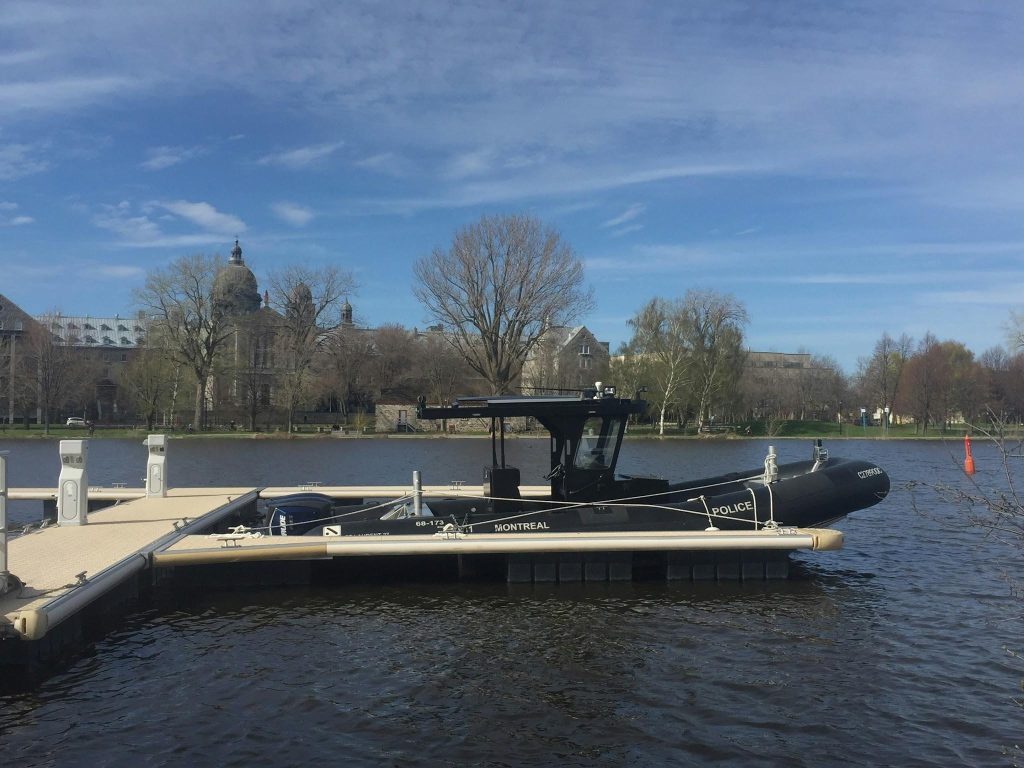
A well-detailed aluminium pontoon in salt water is a multi-decade asset, and the thing that eventually ends it is almost never the slow uniform wasting that people picture when they think about corrosion. Structures of this kind fail locally, at a handful of predictable places, and every one of those places is decided on a drawing rather than by the sea.
That is the useful answer for a client comparing offers. Asking how long the metal lasts produces a marketing number. Asking how the fasteners are isolated and where the water drains produces an answer that actually predicts service life.
Why aluminium survives in the sea at all
Aluminium is a reactive metal that protects itself. Exposed to air it forms a thin, tightly bonded oxide film, and that film reforms almost instantly wherever it is scratched. In a marine environment this passive layer is what stands between the metal and the water, and its behaviour, rather than the bulk properties of the alloy, explains most of what happens over thirty years.
The film has conditions. It needs oxygen to reform, it is stable across a broad but not unlimited range of water chemistry, and it can be broken down locally by chlorides. Each of the common failure modes below is a case of the film being prevented from doing its job in one small area while the rest of the structure carries on unaffected.
Which alloys belong in the water
Structural aluminium is not one material, and the marine grades are a specific family. The 5xxx series, alloyed with magnesium, is the traditional choice for plate in contact with sea water: 5083 carries around 4.5 per cent magnesium and offers the highest strength of the non-heat-treatable marine grades, while 5086 sits in a similar range. Both keep their strength well after welding, which matters because a float is a welded pressure-tight volume.
The 6xxx series, alloyed with magnesium and silicon, is heat-treatable and extrudes well, which makes it the natural choice for frames, beams and deck sections. A typical pontoon is therefore a mixed build: 5xxx plate where the metal is wet, 6xxx extrusions where it is structural. A specification that names one alloy for the whole unit has usually been written from a catalogue.
What actually goes wrong
Four mechanisms account for nearly all of it, and they are all local.
Pitting. Chlorides break the oxide film at isolated points and attack continues into the metal while the surrounding surface stays bright. Pitting is cosmetically alarming and structurally slow, but it is the mechanism that eventually perforates a float wall. Reported exposure work on 5083 found the deepest pitting in the atmospheric zone rather than in the tidal range, which is the opposite of most people’s intuition and a good reason not to treat the parts above the waterline as the easy ones.
Crevice corrosion. Wherever two surfaces are close but not sealed, water gets in, oxygen does not get replenished, and the film cannot reform. Lap joints, washers, the underside of bolted fittings and the gap behind a cleat are the classic sites. This is a detailing failure rather than a material one, and it is the single most avoidable item on the list.
Galvanic contact. Couple aluminium directly to stainless steel or to galvanised components in an electrolyte and the aluminium becomes the sacrificial partner. Fittings, fasteners, hinges and the shore connection are where this happens, and it proceeds quickly enough to matter over a single season if the contact area is unfavourable.
Erosion. Resistance in still water is very good, and it falls as water velocity rises. On most landing stages this is irrelevant; alongside a propeller wash or in a fast channel it is not, and it is worth flagging to the designer rather than assuming the general case applies.
The detailing that decides the answer
Isolate dissimilar metals with non-conductive bushes and washers wherever a fastener passes through, and choose fastener materials deliberately rather than by what is on the shelf. Design out crevices by continuous welding rather than intermittent, and by sealing joints that cannot be eliminated. Make sure every surface drains, because standing water is the condition all four mechanisms above prefer, and stagnant fresh water trapped in a section is harder on aluminium than moving sea water outside it.
Where isolation is genuinely impossible, sacrificial anodes take the load instead, and they are a consumable that has to appear in the maintenance plan rather than a fit-and-forget item. These decisions belong in the design review, alongside the freeboard and buoyancy figures that size the floats, because they are settled at the same moment and by the same drawings.
What maintenance actually consists of
Very little, which is the point, but not nothing. Fresh-water washing removes the chloride deposits that drive pitting above the waterline. An annual walk-over checks fixings, isolation details and anode consumption, and a diver or a lift check on the floats at a longer interval confirms nothing has been struck. The work is measured in hours rather than days, and it is the difference between a structure that reaches its design life and one that needs floats replaced at year fifteen.
None of this is specific to aluminium. The comparison worth making is what the equivalent programme costs on a steel structure in the same water, where the coating system rather than the metal sets the interval and the repaint eventually dominates the whole-life figure.
What to require in the tender
Ask for the alloy and temper of each major component rather than a single grade for the structure. Ask what fastener material is used and how isolation is achieved at every aluminium-to-other-metal interface. Ask whether anodes are fitted, where, and at what expected replacement interval. Ask for the drainage arrangement to be shown on the general arrangement.
Those four questions take a paragraph and they separate suppliers who have built for salt water from suppliers who have built a deck. They are also answerable at tender stage, which means the comparison happens before award rather than at the first inspection.
Before the structure is ordered
Service life in sea water is a design outcome, not a property of the shopping list. The metal is capable of thirty years and more; whether it gets there depends on whether the drawings kept water moving, kept dissimilar metals apart and left nowhere for chlorides to sit.
Our aluminium floating structures are detailed with those four mechanisms in mind and delivered with a maintenance schedule that names the checks and their intervals, so the client knows what the service life assumes rather than being told a number.