


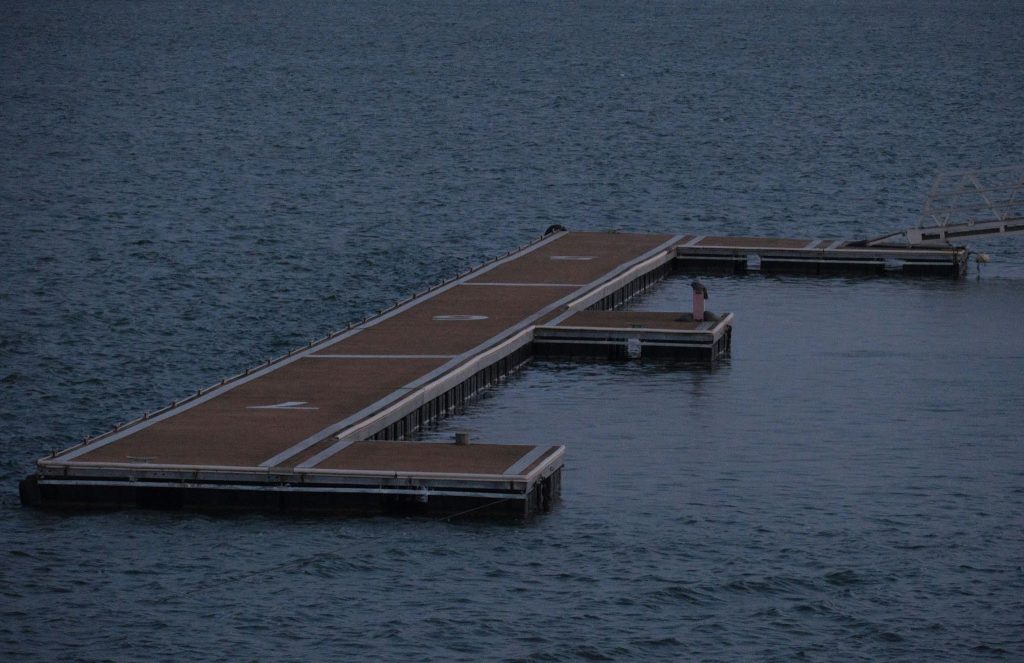
The difference between a pontoon and a jetty is that a pontoon floats and a jetty does not. Everything else about the two words is regional habit, and a good deal of it contradicts itself from one country to the next. That would be a harmless linguistic curiosity except that the words end up in tender documents, where they are read by engineers who assume they mean something precise.
A client writing a brief for a waterfront project does not need the vocabulary settled. They need to know which distinction changes what they will pay for and what they will have to apply for, and there is really only one.
What the words are usually taken to mean
The common usages are worth stating plainly, with the warning that usage varies and that no standard enforces any of it.
| Term | Usual meaning | Fixed or floating |
|---|---|---|
| Quay | Runs along the shore | Fixed |
| Wharf | Decked structure on piles | Fixed |
| Pier | Projects out from the shore | Fixed |
| Jetty | Narrow structure into the water | Usually fixed |
| Pontoon | Deck carried on floats | Floating |
Two of these deserve a caveat. Jetty is used in coastal engineering for a structure built to control currents and protect a shoreline, and in ordinary commercial use for any narrow projecting berth, which are not the same thing at all. Pontoon is used for the floats themselves, for the floating deck they carry, and in some markets for a small leisure boat, so the word on its own carries almost no information.
The distinction that actually costs money
Strip away the vocabulary and one question remains: does the deck stay at a constant height above the water, or at a constant height above the bed? That is the difference between floating and fixed, and it determines nearly everything downstream.
A fixed structure needs foundations in the bed. That means piling or ground works in water, a marine plant, a longer programme and a permit process that treats the works as a permanent intervention in the watercourse. A floating structure needs an anchoring system and a connection to land, and in many jurisdictions it is treated as a reversible installation, which is a materially easier application.
The second consequence is behavioural. A fixed deck holds its level while the water rises and falls around it, so the step down to a boat changes through the day and through the season. A floating deck holds its level relative to the water, so the step down is constant and the access gangway takes the variation instead. Where water levels move significantly, that difference decides whether the berth is usable at both extremes or only at one.
Where each one wins
Fixed structures suit sites with small water-level variation, heavy point loads, vehicle access or a requirement for a rigid deck that will not move under any circumstance. They also suit situations where the bed is suitable for foundations and the client wants a structure that needs almost no attention for decades.
Floating structures suit sites with significant level variation, soft or contaminated beds where foundations are expensive or unwelcome, and projects where reversibility is part of the consent. They also suit staged projects, because a floating layout can be extended or rearranged later in a way a piled deck cannot. The trade-off is a mooring system that has to be inspected and eventually replaced, which is a maintenance line a fixed structure does not have.
The comparison is set out in more detail in our analysis of how a floating pontoon compares with a fixed pier for public waterfront work, where the deciding factors usually turn out to be the bed conditions and the consent regime rather than the structure itself.
What a brief should say instead of naming a type
The most useful thing a client can do is describe the site and the use rather than the product. State the highest and lowest water levels expected. Say what will berth against the structure and how heavy it is. Say whether vehicles or only people will use the deck. Say whether the installation has to be removable.
Answer those four and the choice between fixed and floating usually makes itself, which is a better outcome than choosing a word first and discovering later that the site does not suit it. It also lets suppliers offer the thing that fits rather than the thing they were asked for.
Aluminium changes the calculation for both
Material choice interacts with the fixed-or-floating decision more than most people expect. A floating structure carries its own weight permanently, so every kilogramme of deck is a kilogramme of buoyancy that has to be bought and a millimetre of freeboard that has to be recovered. Aluminium weighs roughly a third of what steel does for the same volume, which shows up directly in the float size and therefore in the cost of the units under the deck.
On a fixed structure the same weight saving shows up in the foundations, and on both it shows up in installation, because lighter modules can be placed with smaller plant. That is why aluminium floating structures and landing stages tend to compare well precisely on the sites where access is difficult and heavy equipment is hard to bring in.
Before the word goes into the document
Nobody is going to standardise this vocabulary, and a project does not need it standardised. What a project needs is for the tender to describe water levels, loads, vessels and reversibility, and to let the word follow the decision rather than lead it.
If a draft brief is already written around one of these terms, it is worth a second read to check which of the two structural families it actually implies. Our engineers will go through a waterfront brief and say which arrangement the site supports, and what each one would mean for the consent application and the programme.