


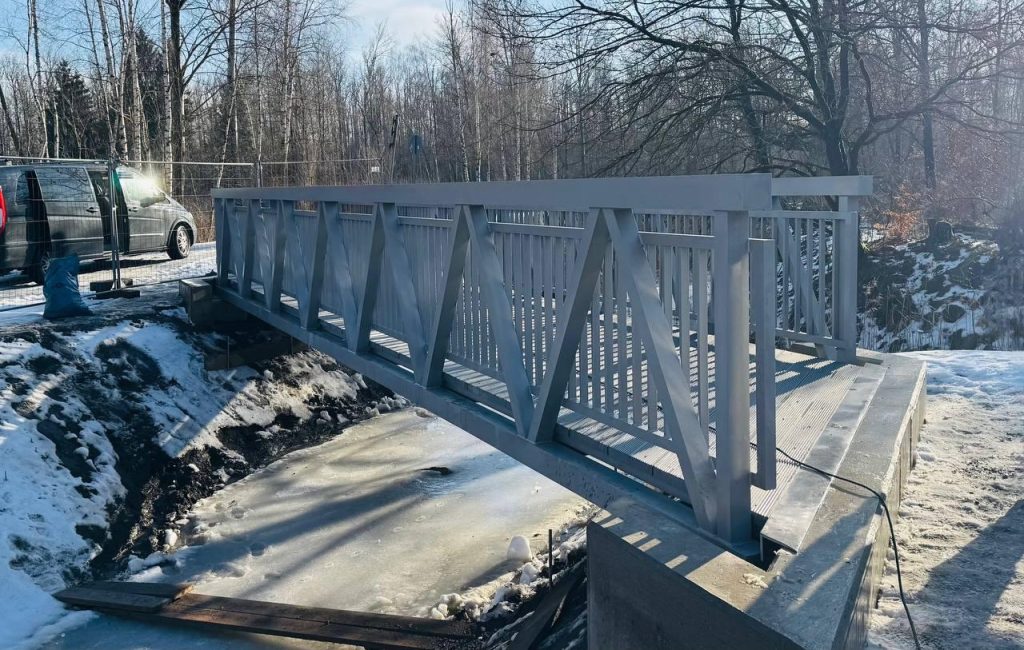
Floating dock ice damage is usually explained as sideways pressure from an expanding sheet, and that mechanism is real. It is also the less destructive of the two. What takes out moorings and tears fittings off a deck in a Nordic winter is vertical movement: ice freezes to the structure, the water level rises underneath it, and the whole assembly is jacked upward with a force nothing in the mooring was sized for.
Understanding which of the two mechanisms a site faces changes the specification completely, because the defences against them are different and a structure protected against one can be entirely exposed to the other.
The vertical mechanism, and why it breaks things
Ice bonds to whatever it surrounds. Once a sheet has formed around the floats, the pontoon and the ice are effectively one body, and any rise in water level lifts both. In a regulated lake, after heavy snowmelt, or during a wind-driven set-up on the Baltic, that rise can be substantial and it happens over hours rather than seasons.
A chain mooring responds by going taut. If the slack range was sized for the open-water level variation rather than for the full annual range, the chain either drags its anchor or parts, and the structure is loose under ice, which is the worst possible state. A pile-guided system responds by riding up the pile, and if the pile does not extend far enough above the highest expected position the collar comes off the top and does not go back on.
Both failures are silent and both are discovered at thaw. This is why the winter water-level range, not the summer one, is the figure the mooring has to be designed against.
The lateral mechanism
Sheet ice expands and contracts with temperature and pushes against anything fixed in it. The pressures involved are large but they act slowly, and a floating structure that is free to move will generally be shoved rather than crushed. The damage from lateral action tends to arrive at break-up instead, when moving floes strike the structure with momentum behind them.
The design response is geometric. Vertical-sided floats give the ice a surface to grip and push against, while sloped or rounded sides encourage the sheet to ride up and release. Fittings that project below the waterline give ice something to catch. Neither point adds cost if it is decided at design stage, and neither can be retrofitted.
Overwinter in place, or take it out
The first decision on a Nordic site is whether the structure stays in the water. Removal eliminates the problem entirely and replaces it with a lifting operation, a storage area and an annual cost, which is acceptable for a small leisure installation and rarely acceptable for public infrastructure that has to stay in service.
Where the structure overwinters, three provisions do most of the work. A mooring with slack or elasticity covering the full winter level range keeps the anchorage intact. Bubblers or circulators keep the water at the hull moving, which prevents a continuous bond forming in the first place. A shore connection designed to disconnect or to accept large relative movement stops the gangway from becoming the weakest element, because a rigid link between a moving deck and a fixed abutment concentrates everything at one point.
Where aluminium helps and where it does not
Low temperature is one of the places where the material genuinely behaves better than the obvious alternative. Aluminium has no ductile-to-brittle transition, so its toughness does not fall away as the temperature drops, and a structure that is tough in September is tough at minus twenty-five. Structural steels have to be selected for toughness at the service temperature, and the consequences of getting that selection wrong are sudden rather than gradual.
What aluminium does not do is resist being crushed by ice any better than another metal of the same section. Lightness is an advantage for installation and for flotation, and it is neutral here. The same principles that govern aluminium crossings built for Nordic winter conditions apply on the water: the material choice removes some failure modes and leaves the environmental loads to be designed for on their merits.
Winter access is part of the same problem
A landing stage that survives the winter structurally can still be unusable through it. Ice on a deck is a slip problem, and the surface specification matters more in February than in July. Drainage that works in summer can be blocked by ice, and standing meltwater refreezes into exactly the hazard the drainage was there to prevent.
The access gangway deserves separate attention because its gradient changes with water level. At the extreme low water of a winter drawdown a gangway that is comfortable in summer can exceed any reasonable accessibility gradient, and if the structure is expected to serve the public year-round, the gradient at the worst case belongs in the specification rather than the gradient at the average one.
What the specification has to state
Give the design water levels, highest and lowest, across the whole year rather than the navigation season. Give the expected ice thickness. Say whether the structure overwinters in place. Say whether de-icing is provided and by whom. Give the maximum acceptable gangway gradient and the water level it applies at.
Those five items are site facts, not engineering preferences, and a supplier cannot invent them. A tender that omits them receives a structure designed for open water, which is what most floating equipment on the market is, and the mismatch surfaces in the first hard winter rather than at handover.
Before the first winter
Most floating structures that fail in the north do not fail because the ice was unusually thick. They fail because the mooring was sized for summer, the hull gave the ice something to hold, or the shore connection could not accept the movement. All three are decided on paper months before anything freezes.
Our engineers will work through a Nordic or Baltic site with the client and put the level range, ice thickness and overwintering decision into the design brief before pricing. The aluminium floating structures we deliver for northern waters are specified around those figures rather than adapted to them afterwards.