


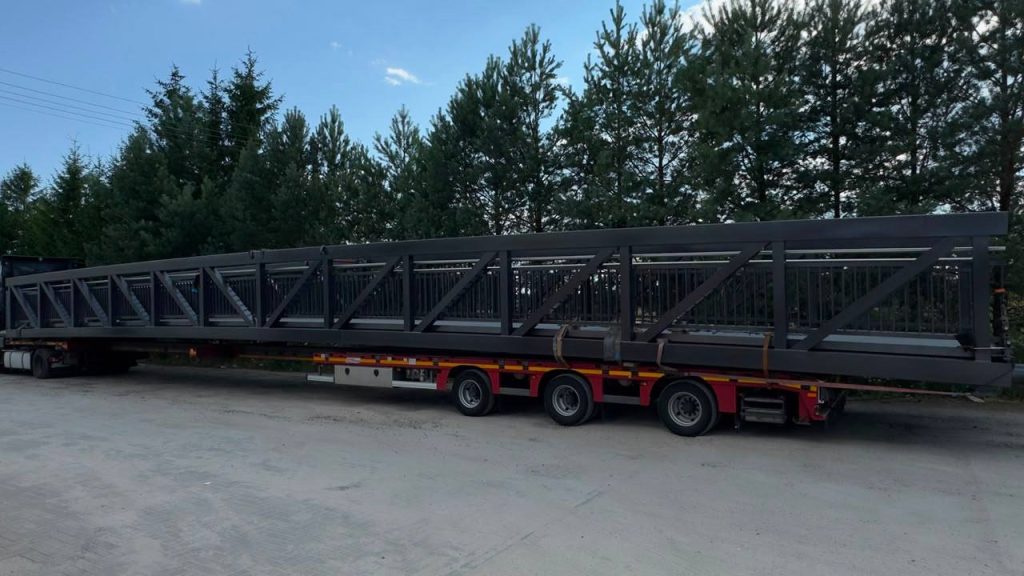
How much a pedestrian bridge costs is a fair question with an unsatisfying answer: there is no price per metre that survives contact with a real site. What exists instead is a cost model with six parts, any one of which can turn out to be the largest, and a short list of site facts that turns the model into a number.
The useful version of this article is therefore not a price list. It is the structure of the cost, so that a client can see which of their own decisions is moving the total and can ask for offers that are actually comparable.
The six parts of the total
Almost every footbridge budget breaks down the same way, and the first surprise for most clients is how little of it is the bridge.
| Package | What it covers |
|---|---|
| Superstructure | The span itself |
| Substructure | Abutments, piles, bearings |
| Approaches | Ramps, stairs, landings |
| Installation | Transport, craneage, closures |
| Professional | Survey, design, approvals |
| Whole life | Inspection, maintenance |
On a simple rural crossing the superstructure dominates and the rest is modest. On an urban crossing over a railway, the approaches and the installation together can exceed the span comfortably, and the professional package is larger than either because of what the infrastructure manager requires.
What actually multiplies the number
Five things do most of the work, and all five are site conditions rather than design choices.
Required clearance. The height the crossing has to achieve sets the rise, the rise sets the ramp length, and ramp length is tonnage, land and civil works together. A structure over a railway is a different budget from one over a footpath for this reason alone, before any of the rail-specific requirements are considered.
Ground conditions. Foundations are the least visible and most variable part of a bridge budget. Competent ground near the surface produces simple pad foundations; soft or contaminated ground produces piling, and piling can rival the cost of the span.
Site access. What can be brought to the site, and what can be closed while it is installed, determines the lifting strategy. A crossing that can be lifted in one piece from an adjacent field is a different operation from one lifted over live infrastructure in a four-hour window at night.
Accessibility. Whether the crossing must be accessible to everyone decides whether the approaches are stairs or ramps, and the gradient that applies at the site then sets how long those ramps have to be. This is frequently the single largest swing in a footbridge budget.
Intent. A functional crossing and a landmark are different products. Architectural ambition is a legitimate choice, and it should be a conscious one rather than something that arrives through a competition brief.
What genuinely reduces it
Four levers work, and they work together rather than separately. A standard design removes engineering hours at the front end. Prefabrication moves work from the site, where it is expensive and disruptive, into a factory where it is not. Bolted assembly on site allows delivery in transportable sections without site welding. Lower dead weight reduces the foundation loads and the size of the lifting equipment, which shows up in two packages at once.
That last point is the structural argument for aluminium rather than a material preference. A span at roughly a third of the weight of the steel equivalent changes what the substructure has to carry and what has to be brought to site, and on constrained urban sites that is often where the saving actually lands.
Why three quotations are usually not comparable
The word bridge covers a different amount of work in each offer. One supplier prices the span; another includes the approaches; a third includes delivery but not lifting; nobody includes the foundations because they depend on a ground investigation the client has not yet commissioned.
The fix is to publish the scope boundary in the tender rather than letting each bidder choose it. Stating explicitly which of the six packages are in scope, and requiring the others to be priced separately as options, converts three numbers into three comparable numbers. The same logic applies when buying a standard prefabricated span, where the boundary is exactly where the confusion arises.
Capital cost is not the whole figure
A crossing is a thirty to eighty year asset, and the coating and inspection regime it implies is part of what is being bought. Two structures with the same capital cost and different maintenance commitments are not the same purchase, and the difference compounds over decades of municipal budgets.
Requiring each bidder to state the maintenance regime their offer assumes, with intervals, is the cheapest way to surface this. It also tends to expose where a low capital figure has been achieved by deferring cost rather than removing it, a comparison set out in our analysis of how aluminium and steel spans compare over their lives.
The eight facts that produce a real price
A supplier can price a crossing accurately from a short list: the clear span between supports, the clear width required, the clearance needed underneath and who set it, the ground investigation results, the access available for delivery and lifting, whether the approaches are in scope and what gradient applies, the country of installation, and the design life expected.
Everything else is refinement. A client who can supply those eight items will get firm numbers; a client who cannot will get ranges with contingency built in, which is the same information priced defensively.
Before the budget is set
The most expensive mistake in a footbridge budget is not choosing the wrong supplier. It is setting the figure from the span before anyone has looked at the ground, the clearance or the approaches, and then discovering that three of the six packages were never in it.
Our engineers will build the cost structure with a client at feasibility stage and say which packages are likely to dominate for that particular site, and the aluminium pedestrian bridges we supply are quoted package by package so the client can see what moves when a requirement changes.