Aluminium bridges, designed and built in the EU

Aluminium bridge manufacturer in Vilnius. Pedestrian, cycle and industrial bridges to EN 1090-3 EXC3 and Eurocode 9.
Oversikt

Aluminium bridge manufacturer certified for public tenders

An aluminium bridge, or aluminum bridge in US English, is a crossing whose load-bearing structure is made of aluminium alloy rather than steel, concrete or timber. DR VERSLAS has manufactured these structures in Vilnius since 2009 for municipalities, civil contractors and industrial sites.

Our aluminium fabrication is certified to EN 1090-3, execution class EXC3, under Kiwa certificate 2268-CPR-434. Structural calculations follow Eurocode 9, and each bridge is supplied with its Declaration of Performance and CE marking. Structures are delivered in sections, on a turnkey basis or as supply only. Check the numbers on our certificates page.
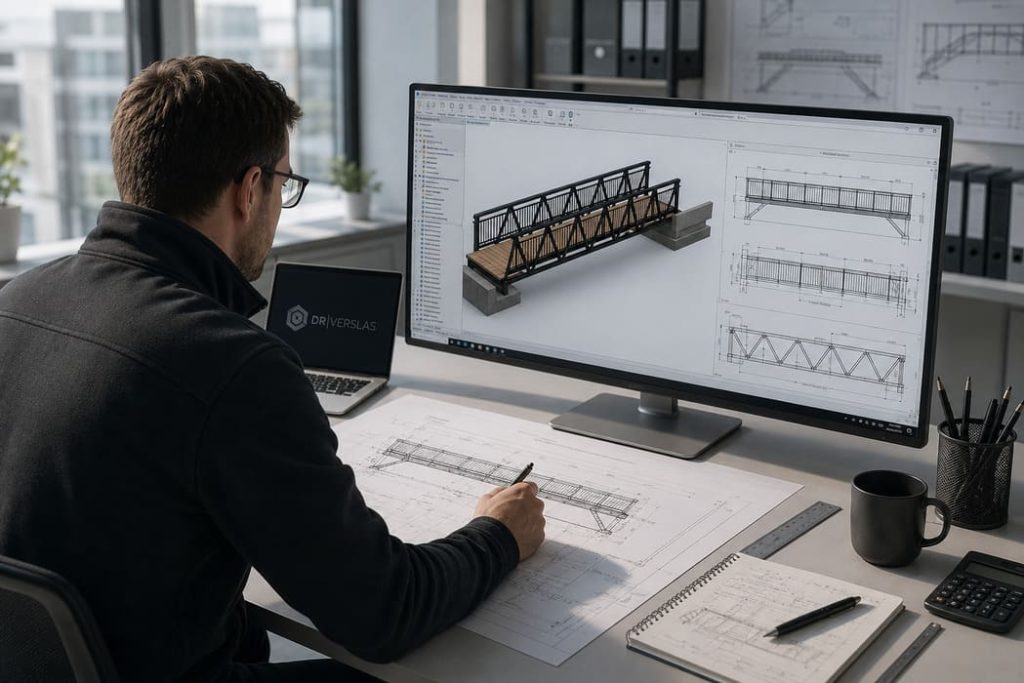
Ingeniør som gjennomgår en 3D-modell av en aluminiumsbru og konstruksjonstegninger på skjermen

Aluminium bridge weight: figures from six delivered structures

The delivered bridges below weighed between 74 and 145 kg per square metre of deck. Weight sets the crane, the transport and the size of the foundations, so it is worth comparing before the design is fixed.

ProjectLengthWidthWeightkg/m² of deckDesign load
Bachstraße, Schwaigern116.6 m4.0 m46.0 t995 kN/m² + 5 t vehicle
Am Stausee, Sohland27.03 m2.5 m5.0 t745 kN/m²
Linteler Kirchweg, Hude22.45 m3.0 m8.5 t1265 kN/m²
Parthe bridge, Leipzig18.4 m3.0 m7.0 t12712 t vehicle
Stadtpark, Doberlug-Kirchhain12.36 m2.0 m2.2 t895 kN/m²
Carl-Metz-Straße, Nußloch8.6 m4.0 m5.0 t1455 kN/m² + 7.5 t vehicle

Deck area is length multiplied by stated width. Figures come from project records of delivered structures. The Parthe figures are as reported by Leipziger Zeitung.

Questions buyers ask an aluminium bridge manufacturer

Who manufactures aluminium bridges in Europe?

DR VERSLAS is a European manufacturer of aluminium bridges, based in Vilnius, Lithuania, with aluminium fabrication certified to EN 1090-3 EXC3. It supplies pedestrian, cycle and industrial bridges with Eurocode 9 calculations and CE marking.

How much does an aluminium footbridge weigh?

On six delivered DR VERSLAS bridges the structure weighed between 74 and 145 kg per square metre of deck. The highest figure belongs to a short, wide bridge designed for a 7.5 t service vehicle.

What certificate should an aluminium bridge manufacturer hold?

The manufacturer should hold a factory production control certificate under EN 1090-1 whose scope names aluminium and the execution class required. For public footbridges that is usually EXC3, the class covered by DR VERSLAS certificate 2268-CPR-434.

Can an aluminium bridge carry service vehicles?

Yes, when it is designed for them. Delivered DR VERSLAS bridges in Schwaigern and Nußloch combine a 5 kN/m² imposed load with service vehicles of 5 t and 7.5 t.

Are aluminium bridges welded or bolted?

Both methods are used. The bridge at Am Stausee in Sohland is fully welded and coated, while the N5 footbridge in Eggenstein-Leopoldshafen is assembled entirely with bolted connections and powder coated.

Referanseprosjekter

Delivered aluminium bridges, with client, size and load

Each project page lists the dimensions, load class and construction of the delivered structure.
Valg av materiale

Aluminium, stål eller betong

For gangbruer, sykkelbruer og de fleste adkomstbruer slår aluminium både stål og betong på seks av sju målbare parametere. Diagrammene viser en 54 m lang gangbru med nyttelast 5 kN/m².
Konstruksjonsvekt

Aluminium er 2,5 ganger lettere enn stål

tonn · typisk 54 m konstruksjon
Aluminium
12 t
Stål
30 t
Betong
48 t
Densitet: aluminium 2,7 g/cm³, stål 7,85 g/cm³. Eksempel: Rene-brua i Østerrike, 55 m i aluminium – 21 t mot ca. 60 t i stål.
Monteringstid

7 ganger raskere montering på byggeplass

uker på byggeplass · fra levering
Aluminium
2 uker
Stål
8 uker
Betong
14 uker
Prefabrikkerte aluminiumsmoduler leveres monteringsklare. Arbeidet på byggeplass består i hovedsak av løfting, ikke produksjon.
CO₂ i livsløpet (produksjon + vedlikehold)

62 % lavere utslipp enn betong

indeksert · betong = 100 % · forutsetter aluminium med resirkulert innhold
Aluminium
38%
Stål
85%
Betong
Uavhengig livsløpsanalyse (LCA) fra COWI: Resirkulert aluminium gir ca. 70 % lavere CO₂-utslipp enn stål. Tallet varierer med andelen resirkulert materiale i det enkelte prosjektet.
Gjenvinning ved endt levetid

Over 95 % gjenvinningsgrad i byggsektoren

% av materialverdien som beholdes ved gjenvinning
Aluminium
95%
Stål
87%
Betong
25%
IAI (International Aluminium Institute): Over 95 % av aluminiumet i byggsektoren gjenvinnes ved endt levetid. Gjenvinning sparer 95 % av energien sammenlignet med primærproduksjon.
Samsvar og dokumentasjon

Anbudsklar dokumentasjon med hvert tilbud

For kommunale, statlige og EU-finansierte prosjekter er sertifisering en del av beslutningsgrunnlaget. Hvert tilbud leveres med full samsvarsdokumentasjon – beregninger, ytelseserklæringer, BIM-modeller og samsvarssertifikater.

✓ Aktiv
Sveiste aluminiumskonstruksjoner
Utførelsesklasse EXC2 for bærende aluminiumskomponenter. CE-merket produksjon.
Kvalitetsstyring
Dokumentert kontroll av prosjektering, produksjon og montering. Revideres årlig.
✓ Aktiv
Dimensjonering av aluminiumskonstruksjoner
NS-EN 1999-1-1 og -1-3 lagt til grunn for alle bærende konstruksjoner. Beregninger fås på forespørsel.
✓ Aktiv
Ytelseserklæring
Ytelseserklæring (DoP) iht. CPR 305/2011 for alle konstruksjoner som omsettes i EU/EØS.
✓ Aktiv
Miljøstyring
CO₂-rapportering for hele livsløpet og dokumentasjon av gjenvinnbarhet for hvert prosjekt.
✓ Aktiv
Sveisekvalitet
Omfattende kvalitetskrav til smeltesveising av metalliske materialer.