Aluminium bridges, designed and built in the EU

Aluminium bridge manufacturer in Vilnius. Pedestrian, cycle and industrial bridges to EN 1090-3 EXC3 and Eurocode 9.
Aperçu

Aluminium bridge manufacturer certified for public tenders

An aluminium bridge, or aluminum bridge in US English, is a crossing whose load-bearing structure is made of aluminium alloy rather than steel, concrete or timber. DR VERSLAS has manufactured these structures in Vilnius since 2009 for municipalities, civil contractors and industrial sites.

Our aluminium fabrication is certified to EN 1090-3, execution class EXC3, under Kiwa certificate 2268-CPR-434. Structural calculations follow Eurocode 9, and each bridge is supplied with its Declaration of Performance and CE marking. Structures are delivered in sections, on a turnkey basis or as supply only. Check the numbers on our certificates page.
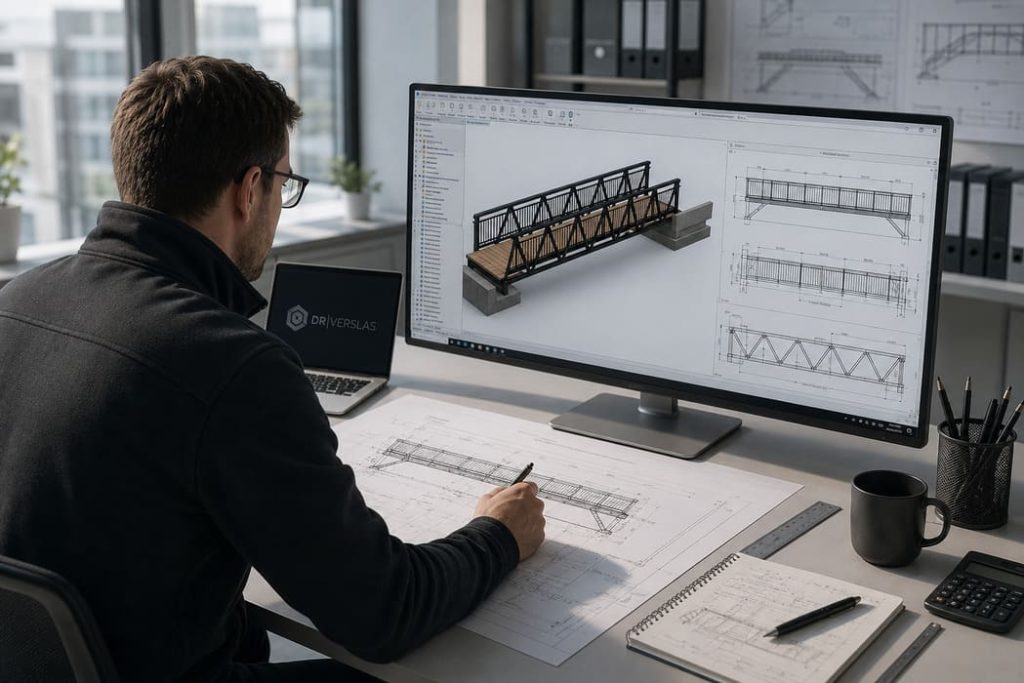
Engineer reviewing a 3D aluminium bridge model and structural drawings on screen

Aluminium bridge weight: figures from six delivered structures

The delivered bridges below weighed between 74 and 145 kg per square metre of deck. Weight sets the crane, the transport and the size of the foundations, so it is worth comparing before the design is fixed.

ProjectLengthWidthWeightkg/m² of deckDesign load
Bachstraße, Schwaigern116.6 m4.0 m46.0 t995 kN/m² + 5 t vehicle
Am Stausee, Sohland27.03 m2.5 m5.0 t745 kN/m²
Linteler Kirchweg, Hude22.45 m3.0 m8.5 t1265 kN/m²
Parthe bridge, Leipzig18.4 m3.0 m7.0 t12712 t vehicle
Stadtpark, Doberlug-Kirchhain12.36 m2.0 m2.2 t895 kN/m²
Carl-Metz-Straße, Nußloch8.6 m4.0 m5.0 t1455 kN/m² + 7.5 t vehicle

Deck area is length multiplied by stated width. Figures come from project records of delivered structures. The Parthe figures are as reported by Leipziger Zeitung.

Questions buyers ask an aluminium bridge manufacturer

Who manufactures aluminium bridges in Europe?

DR VERSLAS is a European manufacturer of aluminium bridges, based in Vilnius, Lithuania, with aluminium fabrication certified to EN 1090-3 EXC3. It supplies pedestrian, cycle and industrial bridges with Eurocode 9 calculations and CE marking.

How much does an aluminium footbridge weigh?

On six delivered DR VERSLAS bridges the structure weighed between 74 and 145 kg per square metre of deck. The highest figure belongs to a short, wide bridge designed for a 7.5 t service vehicle.

What certificate should an aluminium bridge manufacturer hold?

The manufacturer should hold a factory production control certificate under EN 1090-1 whose scope names aluminium and the execution class required. For public footbridges that is usually EXC3, the class covered by DR VERSLAS certificate 2268-CPR-434.

Can an aluminium bridge carry service vehicles?

Yes, when it is designed for them. Delivered DR VERSLAS bridges in Schwaigern and Nußloch combine a 5 kN/m² imposed load with service vehicles of 5 t and 7.5 t.

Are aluminium bridges welded or bolted?

Both methods are used. The bridge at Am Stausee in Sohland is fully welded and coated, while the N5 footbridge in Eggenstein-Leopoldshafen is assembled entirely with bolted connections and powder coated.

Projets de référence

Delivered aluminium bridges, with client, size and load

Each project page lists the dimensions, load class and construction of the delivered structure.
Justification des matériaux

Aluminium contre acier contre béton

Pour les applications de passerelles, de ponts cyclables et de la plupart des ponts d'accès, l'aluminium surpasse l'acier et le béton sur six paramètres mesurables sur sept. Le tableau ci-dessous : passerelle de 54 m, classe de charge de 5 kN/m².
Poids structurel

L'aluminium est 2,5 fois plus léger que l'acier

tonnes · structure typique de 54 m
Aluminium
12 t
Acier
30 tonnes
Béton
48 t
Densité Al 2,7 g/cm³ contre acier 7,85 g/cm³. Projet réel : Pont René, Autriche, 55 m en aluminium — 21 t contre ~60 t en acier.
Temps d'installation

Installation sur site 7 fois plus rapide

semaines sur site · à partir de la livraison
Aluminium
2 semaines
Acier
8 semaines
Béton
14 semaines
Les modules préfabriqués en aluminium arrivent prêts à être installés. Le temps sur site est principalement consacré au levage, pas à la fabrication.
Cycle de vie du CO₂ (fabrication + maintenance)

Le 62% génère moins d'émissions que le béton

indexé · béton = 100% · sur la base d'un aluminium contenant des matériaux recyclés
Aluminium
38%
Acier
85%
Béton
Analyse du cycle de vie (ACV) indépendante réalisée par COWI : l'aluminium recyclé permet de réduire les émissions de CO₂ d'environ 701 tonnes par rapport à l'acier. Ce chiffre varie en fonction de la part de matériaux recyclés utilisée dans le projet concerné.
Récupération en fin de vie

Taux de recyclage du 95%+ dans le secteur de la construction

1 tonne de matière première conservée sous forme de matériau recyclé
Aluminium
95%
Acier
87%
Béton
25%
IAI (Institut international de l'aluminium) : plus de 951 000 tonnes d'aluminium utilisé dans le secteur du bâtiment sont recyclées en fin de vie. Le recyclage permet d'économiser 951 000 tonnes d'énergie par rapport à la production primaire.
Conformité

Documentation prête à l'appel d'offres avec chaque devis

Pour les traversées financées par les municipalités, les gouvernements fédéraux et l'UE, la certification fait partie de la décision d'achat. Chaque devis est accompagné du dossier de conformité complet : calculs, déclarations de performance, modèles BIM et certificats de conformité.

✓ Actif
Structures en aluminium soudé
Classe d'exécution EXC2 pour composants porteurs en aluminium. Production avec marquage CE.
Gestion de la qualité
Contrôle documenté sur la conception, la production et l'installation. Audit annuel.
✓ Actif
Conception structurelle en aluminium
En 1999-1-1, -1-3 s'appliquaient à toutes les structures porteuses. Calculs disponibles.
✓ Actif
Déclaration de performance
Documentation complète relative à la déclaration de performance (DoP) conformément au règlement (UE) n° 305/2011 pour chaque produit mis sur le marché de l'Union européenne.
✓ Actif
Gestion environnementale
Rapport sur le CO₂ durant le cycle de vie et documentation sur la recyclabilité fournis par projet.
✓ Actif
Qualité de soudage
Exigences complètes en matière de qualité pour le soudage par fusion des matériaux métalliques.