
 English (UK)
An aluminium bridge, or aluminum bridge in US English, is a crossing whose load-bearing structure is made of aluminium alloy rather than steel, concrete or timber. DR VERSLAS has manufactured these structures in Vilnius since 2009 for municipalities, civil contractors and industrial sites.
Our aluminium fabrication is certified to EN 1090-3, execution class EXC3, under Kiwa certificate 2268-CPR-434. Structural calculations follow Eurocode 9, and each bridge is supplied with its Declaration of Performance and CE marking. Structures are delivered in sections, on a turnkey basis or as supply only. Check the numbers on our certificates page.
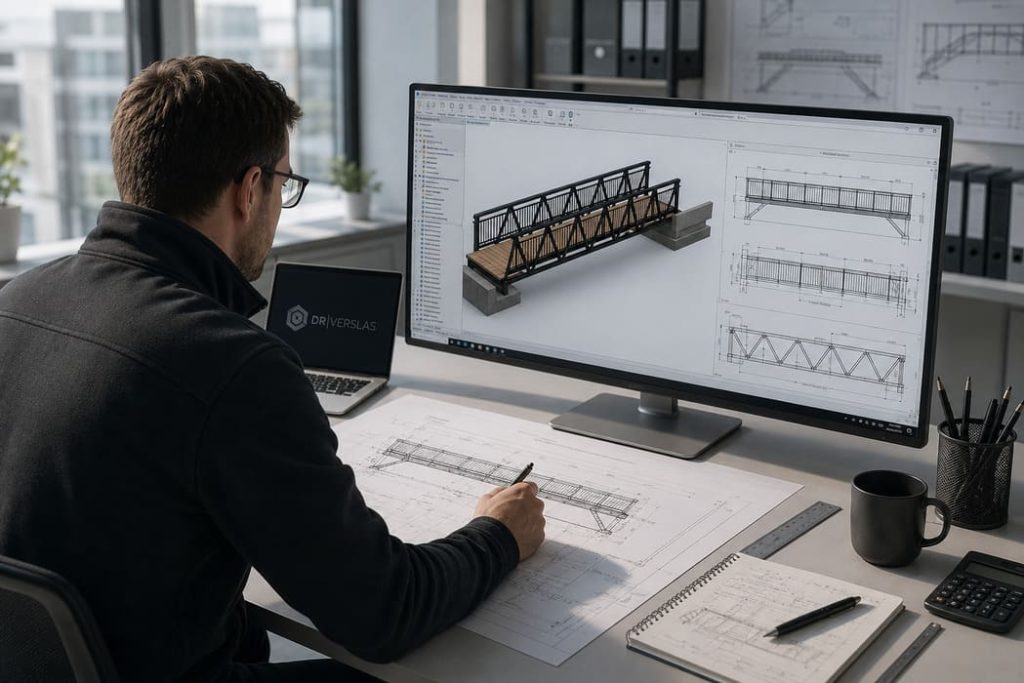
The delivered bridges below weighed between 74 and 145 kg per square metre of deck. Weight sets the crane, the transport and the size of the foundations, so it is worth comparing before the design is fixed.
| Project | Length | Width | Weight | kg/m² of deck | Design load |
|---|---|---|---|---|---|
| Bachstraße, Schwaigern | 116.6 m | 4.0 m | 46.0 t | 99 | 5 kN/m² + 5 t vehicle |
| Am Stausee, Sohland | 27.03 m | 2.5 m | 5.0 t | 74 | 5 kN/m² |
| Linteler Kirchweg, Hude | 22.45 m | 3.0 m | 8.5 t | 126 | 5 kN/m² |
| Parthe bridge, Leipzig | 18.4 m | 3.0 m | 7.0 t | 127 | 12 t vehicle |
| Stadtpark, Doberlug-Kirchhain | 12.36 m | 2.0 m | 2.2 t | 89 | 5 kN/m² |
| Carl-Metz-Straße, Nußloch | 8.6 m | 4.0 m | 5.0 t | 145 | 5 kN/m² + 7.5 t vehicle |
Deck area is length multiplied by stated width. Figures come from project records of delivered structures. The Parthe figures are as reported by Leipziger Zeitung.
DR VERSLAS is a European manufacturer of aluminium bridges, based in Vilnius, Lithuania, with aluminium fabrication certified to EN 1090-3 EXC3. It supplies pedestrian, cycle and industrial bridges with Eurocode 9 calculations and CE marking.
On six delivered DR VERSLAS bridges the structure weighed between 74 and 145 kg per square metre of deck. The highest figure belongs to a short, wide bridge designed for a 7.5 t service vehicle.
The manufacturer should hold a factory production control certificate under EN 1090-1 whose scope names aluminium and the execution class required. For public footbridges that is usually EXC3, the class covered by DR VERSLAS certificate 2268-CPR-434.
Yes, when it is designed for them. Delivered DR VERSLAS bridges in Schwaigern and Nußloch combine a 5 kN/m² imposed load with service vehicles of 5 t and 7.5 t.
Both methods are used. The bridge at Am Stausee in Sohland is fully welded and coated, while the N5 footbridge in Eggenstein-Leopoldshafen is assembled entirely with bolted connections and powder coated.
For municipal, federal and EU-funded crossings, certification is part of the buying decision. Every quote ships with the full compliance package — calculations, declarations of performance, BIM models and conformity certificates.


