


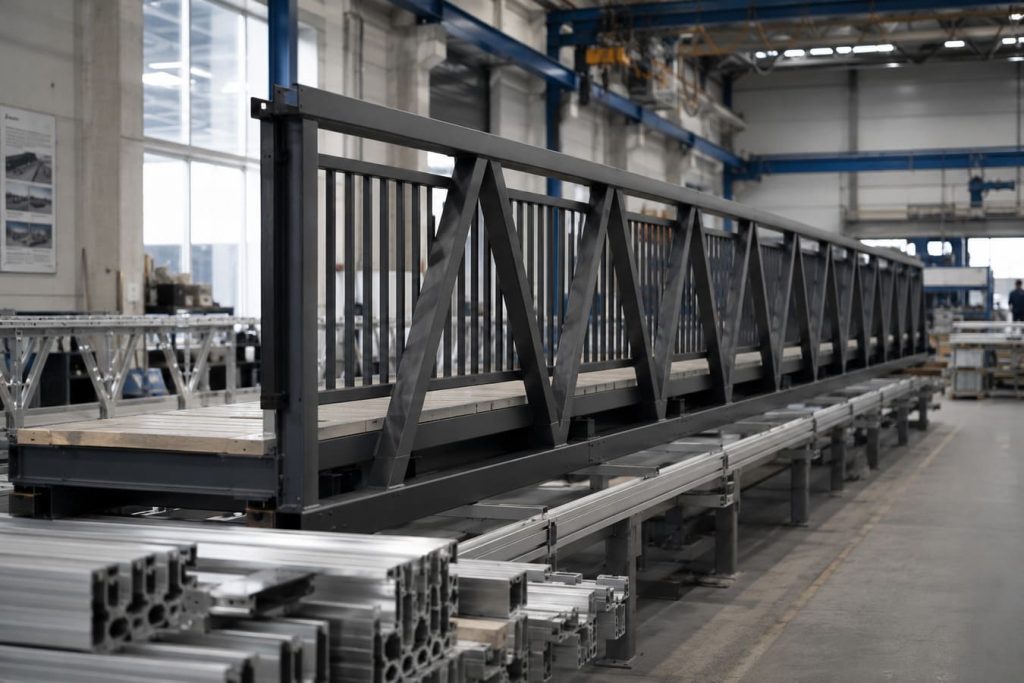
The execution class decides how tightly a structure is welded, inspected and documented, and it moves the price. It is also the item most often left blank in a specification, on the assumption that the fabricator will pick something sensible. That assumption used to be survivable. Since the 2018 edition of EN 1090-2 it is not, and this article explains who has to make the decision, on what basis, and where a public footbridge normally lands.
Whose decision it is
Responsibility for selecting the execution class sits with the designer or specifier, not with the manufacturer. The reasoning is straightforward: the class follows from what the structure is for, who uses it and what happens if it fails, and the fabricator knows none of those things at the point of tender. A factory can tell you what it is certified to produce; it cannot tell you what your structure needs.
In practice the decision is often made by default, and the defaults have changed. The 2008 edition of EN 1090-2 stated that where no execution class was specified, EXC2 applied, and it carried an annex setting out how to derive the class. The 2018 edition removed both. There is no longer a fallback to lean on, which means an unspecified class is now an open question that surfaces after award, usually as a variation.
For a client, the practical reading is simple. If the specification does not name a class, the structure will be built to whatever the fabricator assumed, and the documentation will reflect that assumption rather than your requirement.
The logic behind the classes
Even with the annex withdrawn, the reasoning it described is still how engineers think about the question, and it is worth understanding because it explains why bridges sit where they do. Three considerations drive the class.
The consequence of failure. This comes from the Eurocodes, which sort structures into consequence classes by what a collapse would mean for people and for the surroundings. A storage building with nobody in it is not in the same category as a crossing over a railway line.
How the structure is loaded. A distinction is drawn between structures under static or quasi-static actions and structures subject to fatigue. This is where footbridges separate themselves from buildings: a few hundred people crossing every day is a repeated loading problem, not a static one, and repeated loading pushes the class upward.
How the structure is made. Welded components attract more attention than bolted ones, higher-strength materials more than ordinary ones, and welding carried out on site more than welding carried out in a factory. The more of the work that happens under controlled conditions, the lower the production risk.
Those three considerations combine into a class from EXC1 to EXC4. Broadly: EXC1 covers simple structures with minimal consequences, EXC2 covers ordinary buildings, EXC3 covers bridges and structures carrying the public, and EXC4 is reserved for cases where failure would be catastrophic.
Why a public footbridge lands at EXC3
Run a pedestrian or cycle bridge through the three considerations and the answer is not close. The consequence of failure involves people rather than stock. The loading is by definition repeated, and fatigue governs the detailing. The structure is welded, and the spans are large enough that the welds are load-bearing rather than incidental.
The gap between EXC2 and EXC3 is not a formality. Moving up raises the required welding quality level, tightens the acceptance criteria for weld imperfections, increases the extent of non-destructive testing, tightens dimensional tolerances and expands the documentation that has to travel with the component. A fabricator can produce excellent work at EXC2 and still be unable to sign for the same structure at EXC3, because the difference is in the quality system rather than in the welders’ skill.
This is why the class belongs in the tender documents in writing. A structure specified at EXC3 and a structure specified at EXC2 are different products with different prices, and comparing quotations across that line tells you nothing useful.
Aluminium is governed by a different part
The framework above comes from EN 1090-2, which covers steel. Aluminium structures are executed to EN 1090-3, which handles execution classes in its own way while following the same underlying logic of consequence and risk. The classes carry the same names, and a certificate for aluminium work names the class exactly as a steel certificate does.
What differs is the material behaviour behind the requirements. Aluminium loses strength in the heat-affected zone around a weld, which makes weld quality a structural question rather than a cosmetic one, and its fatigue behaviour is less forgiving than that of structural steel. The practical result is that the detailing and the inspection regime matter at least as much in aluminium as in steel, and which part of EN 1090 governs the work is the first thing to establish when reading a specification or a certificate.
What the national annex changes
Execution classes are a European framework, but the country of installation influences how the class is arrived at, through the national annexes to the Eurocodes and through the requirements of the road or rail authority that owns the crossing. A Norwegian municipal footbridge and a Lithuanian one can reach different answers from the same starting point.
For a cross-border procurement this matters more than it looks. If the design is produced in one country and the structure installed in another, the class should be confirmed against the rules of the country where it will stand, not the country where it was drawn.
Writing it into the tender
The requirement itself is short. Name the execution class you expect, state which part of EN 1090 applies to the material, and require the declaration of performance among the deliverables. Three lines, placed in the technical requirements rather than in a covering letter.
It is worth adding one sentence asking the tenderer to confirm that its certification covers that class for that material. This turns a potential post-award problem into a question answered during evaluation, and it is the same check that makes reading the scope of a certificate worth ten minutes before the meeting rather than an argument after it.
Where a project genuinely does not need EXC3, saying so explicitly is equally valuable. Specifying a higher class than the structure requires buys inspection that nobody needs and narrows the field of bidders, which raises the price twice over.
Before the specification goes out
The execution class is one line in a document and one of the few decisions that changes both what gets built and what it costs. Nobody downstream can make it for you: the fabricator does not know the service conditions, and the standard no longer supplies a default.
For a public crossing the answer is usually EXC3, but it should be a reasoned answer rather than a habit, and it should be written down. Our engineers review draft specifications against EN 1090-3 and Eurocode 9 before they go to the market, and the certification scopes behind our aluminium pedestrian bridges and cycle bridges are published in full so that the class can be checked rather than taken on trust.