


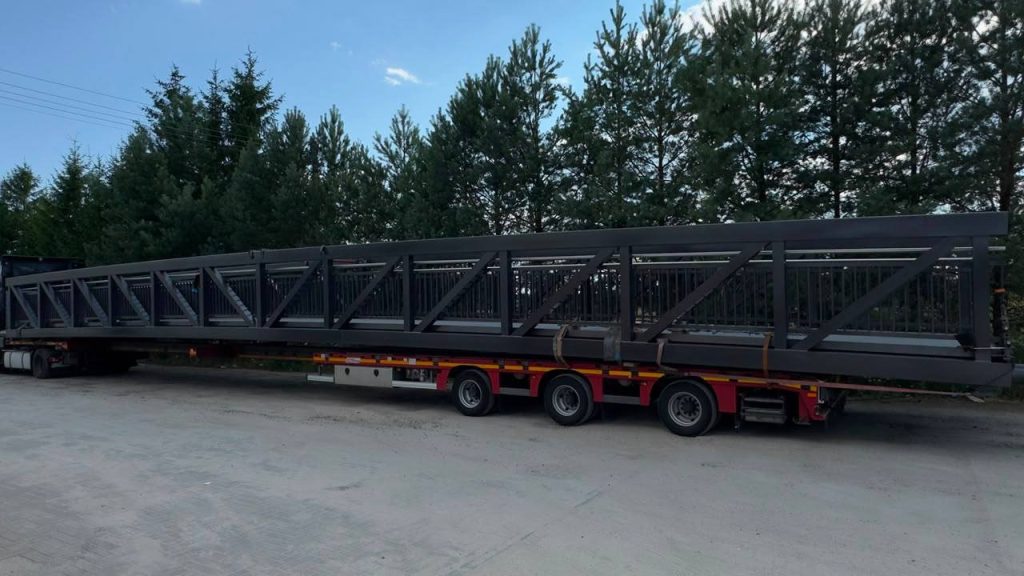
EN 1090 is the European standard that governs how load-bearing steel and aluminium structures are manufactured, not how they are designed. It comes in five parts: part 1 sets the rules for CE marking a structural component, parts 2 and 3 give the technical requirements for steel and for aluminium, and parts 4 and 5 deal with cold-formed sheeting. When a supplier states that it is certified, it means a notified body has audited its factory production control against part 1. What that statement is actually worth to you depends on two things nobody puts in the marketing copy: which execution class the certificate covers, and whether it covers the material you are buying.
Most of what is published about the standard explains how a fabricator becomes certified, and that side is covered further down, because knowing what a supplier had to go through is half of knowing what its certificate is worth. The harder question usually comes later: a tender response is open in front of you with a certificate attached, and you have to decide whether it applies to the structure you are actually buying.
What EN 1090 actually is
EN 1090 is a harmonised European standard for the execution of steel and aluminium structures, where execution means fabrication, welding, surface treatment, assembly and installation. It sits under the Construction Products Regulation, and that is the reason it exists at all: any load-bearing structural component placed on the European market has to carry a CE marking, and EN 1090-1 is the route to it.
The word execution is doing a lot of work in that sentence. The standard does not tell an engineer how thick a beam should be or what load a footbridge must carry. It tells a factory what it has to control, document and prove while turning that engineer’s drawing into a physical structure, and it tells a notified body what to audit.
For a public client the practical consequence is straightforward. A structure without EN 1090-1 certification behind it cannot be legally CE marked, and a component that cannot be CE marked cannot be lawfully installed in an EU construction project. That is why the certificate turns up in tender qualification long before anyone looks at a price.
The five parts, and which one covers aluminium
Most articles on the subject mention three parts and stop. There are five, and the two that get left out matter if your project includes decking or cladding alongside the structure itself.
| Part | What it covers | Relevant when you buy |
|---|---|---|
| EN 1090-1 | Conformity assessment, CE marking | Always |
| EN 1090-2 | Execution of steel structures | Steel spans and supports |
| EN 1090-3 | Execution of aluminium structures | Aluminium bridges, walkways, platforms |
| EN 1090-4 | Cold-formed steel sheeting | Roof, wall and floor decking |
| EN 1090-5 | Cold-formed aluminium sheeting | Roof, wall and floor decking |
For an aluminium footbridge, walkway or viewing platform, the part that governs the work is EN 1090-3, currently in its 2019 edition. It covers structures made from rolled sheet, strip and plate, from extrusions, from cold drawn rod, bar and tube, and from forgings and castings, which between them account for every element of a welded aluminium span. It applies both to structures under predominantly static load and to structures subject to fatigue, and that second case is the one that catches people out: a footbridge with a few hundred crossings a day is a fatigue problem, not a static one.
Here is the trap in a certificate. EN 1090-1 certification is issued for a scope, and that scope names the material and the execution class. A fabricator certified for steel structures to EXC2 is genuinely certified, and that certificate says nothing at all about its right to CE mark an aluminium bridge. Read the scope line, not the logo.
What EN 1090 does not cover
The single most common misunderstanding in tender documents is treating EN 1090 as though it covered design. It does not. Design of aluminium structures is Eurocode 9, published as EN 1999, and the two standards answer different questions.
Eurocode 9 decides whether the structure is strong enough: section sizes, joint capacity, deflection, fatigue life, stability. EN 1090-3 decides whether the structure that arrives on site is the one Eurocode 9 described: the right alloy and temper, welds that meet the specified quality level, tolerances inside the permitted range, surface treatment applied as specified, documentation that proves all of it.
A specification that demands certification but never names Eurocode 9 has asked for good manufacturing of an undefined structure. A specification that names Eurocode 9 and omits EN 1090 has asked for a correct calculation with no control over what is welded. Both appear in real tenders, and both are expensive to fix after award.
Execution classes: what EXC1 to EXC4 change
The execution class is the part of the standard that actually changes the price, the lead time and the level of inspection your structure receives. There are four, running from EXC1 to EXC4, and the class is selected from the consequences of failure: how many people are affected, how the structure is loaded, what happens if a weld fails.
| Class | Typical structure | Welding quality level |
|---|---|---|
| EXC1 | Simple, low consequence parts | EN ISO 3834-4 |
| EXC2 | Ordinary buildings, light structures | EN ISO 3834-3 |
| EXC3 | Public bridges, crowd-loaded structures | EN ISO 3834-2 |
| EXC4 | Extreme consequences of failure | EN ISO 3834-2 |
Moving from EXC2 to EXC3 is not a formality. It raises the required welding quality level, tightens acceptance criteria for weld imperfections, increases the extent of non-destructive testing, tightens dimensional tolerances and expands the documentation that has to accompany the component. A fabricator can produce an excellent EXC2 structure and still be unable to sign for the same structure at EXC3, because the gap is in the quality system rather than in the welder’s hands.
For a public pedestrian or cycle bridge, EXC3 is the class a specifier should expect to see, and it is worth writing into the tender explicitly rather than assuming it. The four classes are a European framework, but the national annex in the country of installation influences how the class is selected, so a Norwegian and a Lithuanian project can land on different answers from the same starting point.
Why the execution class decides the welding standard
The standard does not write its own welding rules. It points at EN ISO 3834 and selects the level from the execution class, which is why the two standards are always mentioned together and are constantly confused with each other. ISO 3834-2 means comprehensive quality requirements, 3834-3 standard requirements, 3834-4 elementary requirements, and the step from EXC2 to EXC3 moves a fabricator from the middle level to the top one.
In practice that step brings in a qualified welding coordinator, welding procedure specifications qualified by test rather than by precedent, welder qualifications kept current for the specific joint types, and traceability from the certificate of the parent material through to the finished weld. Aluminium raises the bar further, because the metal is unforgiving about heat input and surface preparation in a way structural steel is not.
There is a design decision hiding behind all of this. A structure assembled with bolted connections rather than site welds keeps every weld inside a controlled factory environment, where the quality system applies and the documentation is generated as part of production. Site welding on a public bridge means recreating those conditions on a riverbank in November, which is possible but rarely cheap.
How a fabricator gets certified, and what the certificate proves
Certification starts on the shop floor rather than in a folder. The fabricator has to build a factory production control system that covers how incoming material is received and traced, how welders and welding procedures are qualified, how dimensions and welds are inspected, and how every one of those checks is recorded. At the higher execution classes the standard also requires a welding coordinator with an appropriate qualification, and it treats that as a named responsibility rather than a line on an organisation chart.
A notified body then audits the plant against EN 1090-1, checks that the system is actually running rather than merely written down, and issues the FPC certificate for a defined scope. The certificate is not permanent. The body comes back for surveillance audits, and certification lapses if the system stops being maintained, which is why the validity date on a certificate deserves as much attention as the logo above it.
From there the chain is short, and tender responses regularly confuse its links. Holding the FPC certificate, the manufacturer may issue a Declaration of Performance for a component and affix the CE marking. The declaration is the manufacturer’s own legal statement of what that component does, and the certificate behind it is what makes the statement credible.
The factory production control system can be built on ISO 9001 or on ISO 3834, but neither of them is a substitute. Both are general quality frameworks, and EN 1090-1 requires a system adapted to its own specific requirements, so a supplier offering ISO 9001 in place of an EN 1090 certificate has answered a different question. It is a reasonable point to raise in a clarification round rather than a reason to disqualify, since a fabricator with a mature ISO 9001 system is usually the one closest to certification.
The Declaration of Performance is also the document most often missing from a delivered package, and the point at which a handover stalls, so it belongs in the list of deliverables you agree with an aluminium bridge supplier before signature rather than in a phone call two weeks before the opening.
How to check a certificate before award
This takes about ten minutes with the tender response open in front of you.
- Find the certificate itself, not a statement about it. It should name a notified body, carry an identification number and show a validity period.
- Read the scope. It names the material, steel or aluminium, and the execution class. Both must match what you are buying.
- Check the execution class against the structure. A public footbridge certified only to EXC2 is a conversation, not a signature.
- Ask which edition of EN 1090-3 the aluminium work follows. The 2019 edition replaced the 2008 one, and a quotation still written to the old version signals a documentation package that has not been updated either.
- Ask for a sample Declaration of Performance from a comparable delivered project. A supplier who has issued them will send one within a day.
The last point sorts the field faster than any of the others. Certification proves the system exists; a real declaration from a real project proves the system has been used.
What this means for an aluminium bridge or walkway
Certification scopes are specific, which is why a supplier’s certificate list is worth reading line by line. DR VERSLAS holds an FPC certificate issued by Kiwa for aluminium structural elements and components at execution class EXC3, and a separate certificate for steel elements at EXC2, both under the Construction Products Regulation. Structural calculations are produced to Eurocode 9, and the assembly is bolted rather than site welded, so the welding that the execution class governs happens in the Vilnius production facility and not on the crossing.
Two certificates for two materials at two different classes is the normal shape of a real certification scope, and any supplier of certified aluminium pedestrian bridges or industrial walkways and access platforms should be able to show you the same breakdown without hunting for it.
Before your next tender goes out
EN 1090 is not a badge, it is a scope with a material and a class attached, and reading that scope takes less time than the clarification round it prevents. The specification you publish should name the execution class you expect, name Eurocode 9 alongside it so the design side is covered, and list the Declaration of Performance among the deliverables rather than assuming it arrives with the structure.
If a structure is already in specification, take the certificate you have been sent and check the two lines that matter, material and class, before the evaluation meeting rather than after it. The certification scopes and Eurocode 9 documentation held by DR VERSLAS are published in full for exactly that check, and our engineers will review a draft specification against EN 1090-3 and Eurocode 9 before it goes out to the market.