


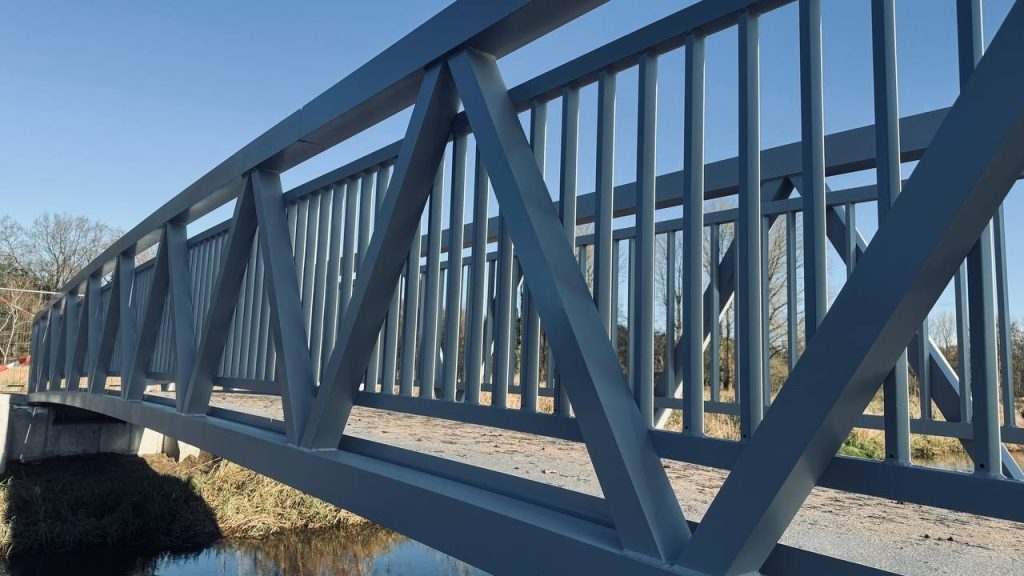
Bridges shake because every structure has natural frequencies at which it prefers to move, and a footbridge is light enough that people walking on it can feed energy into those frequencies. The motion is a serviceability problem rather than a strength problem: a crossing that feels unpleasant underfoot is almost always carrying its loads with a comfortable margin while doing it.
That distinction matters because it tells a client where the fix lives. Nobody solves liveliness by asking for a stronger bridge. It is solved by putting two numbers in the tender document, and by asking for them before the geometry is fixed rather than after the structure is standing.
Why footfall is the load that matters
A person walking puts down roughly two steps a second, so the vertical forcing from a pedestrian sits around 2 Hz, and running raises it to something closer to 2.5 or 3 Hz. Sideways the picture is different and more troublesome: body weight shifts from one foot to the other once per pair of steps, so the lateral forcing arrives at about half the vertical rate, near 1 Hz.
If a structure happens to have a natural frequency near either of those, each step arrives in time with the motion already underway and the response builds. This is the same mechanism as pushing a child on a swing, and it is why a footbridge can be perfectly quiet under one person and unacceptable under fifty.
What the Eurocode actually requires
EN 1990 handles this through its annex on bridges, and the structure of the requirement is a screening test followed by a check. A verification of the comfort criterion is required where the fundamental frequency falls below 5 Hz for vertical vibration, or below 2.5 Hz for lateral and torsional vibration. Above those thresholds the structure is far enough from the forcing frequencies that no further work is needed.
Where the check is required, it is made against recommended acceleration limits: 0.7 m/s² for vertical vibration and 0.2 m/s² for lateral, with 0.4 m/s² permitted laterally in exceptional situations where large crowds are anticipated. Those are the numbers that define comfortable, and they are the numbers that belong in a specification.
| Check | Trigger | Limit |
|---|---|---|
| Vertical | Below 5 Hz | 0.7 m/s² |
| Lateral | Below 2.5 Hz | 0.2 m/s² |
| Lateral, crowds | Below 2.5 Hz | 0.4 m/s² |
The lateral case is the one that makes the news
Vertical bounce is uncomfortable and self-limiting: people find it unpleasant and slow down, which detunes the excitation. Sideways motion behaves differently. A crowd on a laterally lively deck instinctively adjusts its gait to stay balanced, and in doing so it synchronises, which feeds the motion rather than damping it. The result is a feedback loop that grows with the number of people on the structure.
This is why the lateral acceleration limit is so much tighter than the vertical one, and why the crowd scenario used in the assessment is as important as the limit itself. A structure checked against a thin stream of pedestrians and opened to a festival is being asked a question it was never assessed for.
Why light structures need this attention more
Frequency is governed by stiffness and mass together, and lightweight construction tends to reduce both. Aluminium is about a third as stiff as steel for the same section, which is part of the reason deflection rather than strength usually governs an aluminium design, and a structure sized by deflection is not automatically a structure with a comfortable frequency.
The honest position is that any light, slender crossing of any material needs the dynamic check taken seriously, and that a supplier who treats it as an afterthought is the risk rather than the metal. A well-designed aluminium span with the check done properly is quiet; an under-assessed one of any material is not.
What the designer can actually change
Three levers exist and they are not equally available. Stiffness can be raised, usually by making the structure deeper, which fixes the frequency and changes the appearance and the cost. Mass can be added, which lowers the frequency and is rarely attractive on a structure chosen for being light. Damping can be increased, which does not move the frequency at all but limits how large the response grows.
Damping is the practical answer on most lively spans, and it is provided by tuned mass dampers: a mass on springs inside the deck, tuned to the problem frequency. They work well, they are unobtrusive, and they are far cheaper to accommodate as a reserved void in the original design than to retrofit into a finished structure. A tender that asks the designer to confirm whether damping is required, and to reserve space for it if there is any doubt, has bought an option for almost nothing.
What to write in the tender
State that the dynamic assessment is required and name the acceleration limits the structure must meet. Name the crowd scenario the assessment is made against, in pedestrians per square metre, because that is the assumption that changes the answer most. Require the computed fundamental frequencies, vertical and lateral, to be declared in the offer rather than after award.
The crowd density is worth thinking about honestly rather than copying. A rural cycle crossing and a bridge beside a stadium are different problems, and the crowd load category chosen for the deck should be consistent with the density used in the dynamic check, since the two are describing the same event.
Before the geometry is frozen
Liveliness is cheap to design out and expensive to correct. The span, the depth and the support arrangement between them settle the natural frequencies, and by the time those are fixed the remaining options are damping or acceptance. Asking for the frequencies at tender stage costs the bidders an hour and tells you which of them has run the analysis at all.
Our engineers declare the vertical and lateral frequencies and the assessed accelerations for every span we quote, and the aluminium pedestrian bridges en Fietspaden we deliver are handed over with the dynamic assessment in the documentation package so the numbers can be checked against what the tender asked for.