


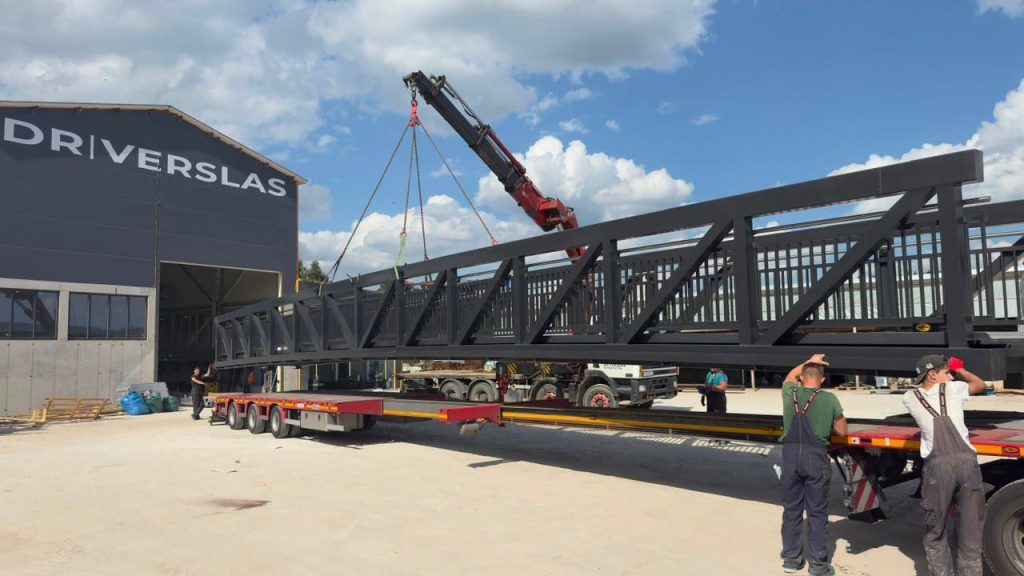
Prefabricated pedestrian bridges for sale sounds like a catalogue purchase: choose a length, agree a price, take delivery. What is actually on offer is a standardised design that still has to be fitted to a particular site, and the site is the part that is never standard.
This is not a complaint about the industry. Standard designs genuinely save money and time. The saving just comes from a different place than clients usually assume, and knowing where it comes from is what makes competing offers comparable.
What is genuinely standardised
The parts of a crossing that repeat from project to project are the ones a supplier can do once and reuse. The cross-section and the way the main girders are made up. The deck system and how it fixes down. The parapet, its posts and their connection into the structure. The splice details where a long span is delivered in sections. The corrosion and finish specification. Above all, the calculation basis: the structural model has been built, checked and used before.
That last item is where most of the value sits. Engineering hours on a bespoke span are substantial, and a standard design converts them into a verification of an existing model against a new set of numbers. The fabrication time barely changes, which is why a standard design shortens the programme at the front end rather than in the workshop.
What is never standard
The span itself is set by where the abutments can go, which is set by ground conditions and land ownership. The skew angle follows the alignment. The deck level follows the clearance required underneath, which comes from a road or rail authority. The approach ramps follow the rise and the national accessibility rule. The foundation loads follow all of the above.
Then there are the requirements that vary by jurisdiction rather than by site: the imposed load category, the parapet height, the national annex that fixes the partial factors and the wind and snow values. A design standardised in one country is a starting point in another, not a finished product.
The practical test for a client is simple. If a supplier quotes without asking about clearance, water levels, ground conditions or the country’s parapet requirement, they have quoted a span rather than a crossing.
Where the scope boundary usually sits
This is the single largest cause of incomparable offers, because the word bridge covers a different amount of work in each one.
| Element | Usually |
|---|---|
| Span and parapets | Supplier |
| Structural calculations | Supplier |
| Abutments and foundations | Client |
| Approach ramps | Varies |
| Delivery and craneage | Varies |
| Ground survey | Client |
The two rows marked as varying are where the money hides. Approach ramps on a crossing with any significant rise can exceed the span in both tonnage and cost, and a price that includes them is not comparable with one that does not. Craneage and delivery on a constrained site can be a five-figure line on its own.
Lead time and what actually drives it
A standard design removes weeks of engineering and it does not remove material procurement, fabrication, surface treatment or transport. Clients who expect a catalogue product to arrive in a fortnight are usually disappointed, while clients who expected six months of design work are pleasantly surprised.
The item that most often extends a programme is not the bridge at all. It is the foundation design, which cannot start until ground investigation is complete, and the possession window where a railway is involved. Both belong on the client’s critical path, and both are frequently discovered after the span has been ordered.
When a standard span is the wrong answer
Standard designs stop paying where the site forces enough modification that the model has to be rebuilt anyway: unusual skew, a curved alignment, a span outside the range the design covers, or an architectural requirement that changes the cross-section. At that point the engineering saving disappears and the sensible route is a design done properly for the site, which is the calculation set out in our comparison of when a bespoke span earns its cost.
The honest version of the trade-off is that a standard design suits an ordinary crossing on an ordinary site, and that most municipal footbridges are exactly that. It is the ten per cent that are not where the money is lost by forcing the standard option.
What to ask before ordering
Ask what the quoted price includes and, specifically, whether abutments, approach ramps, delivery and lifting are in or out. Ask which national annex the standard design was verified against and what re-verification your country requires. Ask what the foundation loads are, because your civils designer needs them before anything can be built. Ask what the clear width is between parapets rather than the overall width. Ask what the lead time assumes about the foundation programme.
Five questions, all answerable in an email, and together they convert a set of prices into a set of comparable prices.
Before the order goes in
A prefabricated crossing is a good way to buy a bridge and a poor way to avoid thinking about a site. The standardisation is real and it lives in the design, the details and the fabrication process rather than in a warehouse.
Our standard aluminium pedestrian bridges are quoted with the scope boundary set out line by line and with the foundation loads stated in the offer, and the reasoning behind assembling as much as possible in the factory is covered in our note on how prefabrication reduces time on site.